




1st Edition
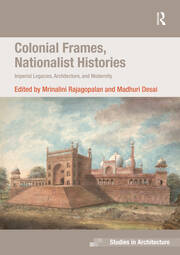
Colonial Frames, Nationalist Histories Imperial Legacies, Architecture, and Modernity
336 Pages
by
Routledge
336 Pages
by
Routledge
Also available as eBook on:
In recent years, there has been a growing debate on the various ways that architecture and urbanism have served the triad of colonialism, nationalism and modernity. Some have argued that newly decolonized nations sought to represent their modernity through the spaces and symbols of their new national capitals, while other scholars have stressed that while the forms and processes of architectural... Read more
Contents: Foreword; Introduction: architectural modernities of imperial pasts and nationalist presents, Mrinalini Rajagopalan and Madhuri Desai; Section 1 Colonial Taxonomies and the Nation's Episteme: Making Indian modern architects, William Glover; In search of the sacred and antique in colonial India, Madhuri Desai; From colonial memorial to national monument: the case of the Kashmiri Gate, Delhi, Mrinalini Rajagopalan. Section 2 Imperial Designs and the Nation's Fragments: Comparative alterities: native encounters and the national museum, C. Greig Crysler; The Black Atlantic and Georgian London, Richard W. Hayes; Almost, but not quite: architecture and the reconstruction of space in the Territory of Hawaii, Kelema Lee Moses. Section 3 Global Vocabularies and Local Products: Redefining the dual city: changing ideas of plural citizenship in colonial/postcolonial Singapore, Anoma Pieris; Beyond racialized representation: architectural linguæ francæ and urban histories in the Kampung houses and shophouses of Meleka and Singapore, Imran bin Tajudeen; Between typologies and representation: the Tong Lau and the discourse of the 'Chinese house' in colonial Hong Kong, Cecilia Chu; Postcolonial Shanghai: an urban discourse of prosperity and futurity, Andrew Law; Index.
Biography
Mrinalini Rajagopalan, University of Pittsburgh, USA and Madhuri Desai, Pennsylvania State University, USA
'Colonial Frames, Nationalist Histories is an ambitious collection of essays that adds much to the growing body of scholarship on global histories of modern architecture and urbanism. Many of the essays in this volume will be welcome not only by historians of the built environment, but by social and cultural historians of empire, historians of nineteenth-century material and visual culture, and art historians interested in the representation of landscape through photography and illustration.' Traditional Dwellings & Settlements Review
