




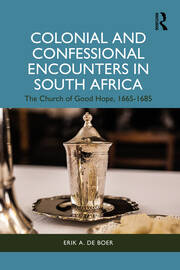
1st Edition
Colonial and Confessional Encounters in South Africa The Church of Good Hope, 1665-1685
By Erik A. de Boer
Copyright 2026
246 Pages
3 Color & 7 B/W Illustrations
by
Routledge
246 Pages
3 Color & 7 B/W Illustrations
by
Routledge
Also available as eBook on:
In the wake of the arrival of the East India Company and its settlement at the Cape of Good Hope, also the Christian faith came to South Africa. In a series of biographical studies, this book looks at the lives of men and women, including the enslaved people, and their relation to the Church.
Based on extensive archival research from both the Netherlands and South Africa, the book uncovers the... Read more
Preface ix
Introduction: The ministry of the Church of Good Hope, 1665–1685 1
1 Joan van Arckel, ‘first resident minister’ 6
1.1 Two ships, a young minister, and a sick comforter 7
1.2 The publication of a disputation 10
1.3 Johannes Hoornbeeck 11
1.4 The conversion of American Indians 13
1.5 A student’s social network 14
1.6 The Indies or the Cape? 15
1.7 ‘Church books’ 16
1.8 A Church with no name 18
1.9 The commander’s spirituality 20
1.10 A rhythm of Church services 23
1.11 Joan van Arckel’s legacy 25
1.12 A window on Van Arckel’s youth 26
2 A mass baptism of slave children 39
2.1 Pierre Casier, another Hoornbeeck student 41
2.2 V.O.C. directors and the classes: conflict over competences 42
2.3 Called to baptize 43
2.4 Wagenaer’s weight 47
2.5 Principle and practice 48
3 Johannes de Vooght and the expected permanent minister 55
3.1 De Vooght, the Amsterdam twins 56
3.2 A minister’s work 56
3.3 The Baldaeus incident 58
3.4 Jacobus Burenus: who decides for the Cape? 61
4 Petrus Wachtendorp and the West Indies Company 67
4.1 Cajana at the Wild Coast 68
4.2 The Maasbommel mystery 70
4.3 Second chances at the Cape 73
4.4 ‘No false testimony’ 74
4.5 Christian discipline 76
4.6 The sale of slaves 77
5 Protest voices against slavery 83
5.1 Ethics of commerce 84
5.2 Catechism class 85
5.3 A pamphlet from Zeeland 87
5.4 Manumission in the early years 93
6 Adrianus de Vooght’s tour of duty 99
6.1 The other De Vooght 99
6.2 Pastoral practice 101
6.3 Baptismal practice 102
6.4 Communicants 104
6.5 Childcare for Koina kids 105
6.6 Marriages and guests 106
6.7 The reverend slave owner 107
7 Rudolph Meerlant, ‘And the lot fell upon him’ 113
7.1 Warship minister 114
7.2 Casting lots 114
7.3 Election of elders and deacons 115
7.4 The Cape’s orphans 117
7.5 Baptismal instruction of Roman Catholic parents 118
8 Petrus Hulsenaer: Taking stock of the flock 122
8.1 Commander Johan Bax and Meerlant’s last report 122
8.2 Experience on outposts 123
8.3 Last will of a young couple 124
8.4 ‘About 70 members’ 125
8.5 Again, baptism of slave children 128
8.6 Stumphius: an unexpected appearance 130
8.7 Baptismal discrimination? 132
8.8 Collegial communication in Latin 133
9 Johannes Overney, a seasoned servant (1678–1687) 140
9.1 Disputation on divine providence 140
9.2 A schoolteacher as minister of the West Indies 142
9.3 The pull of the East Indies 144
9.4 The policy of baptism revisited 145
9.5 Van Reede’s reform (1685) 149
9.6 From refreshment base to colony 153
9.7 Caring for the slaves and the colony’s future 155
9.8 Baptism reconsidered 156
9.9 Pastoral care of visiting Jesuits 157
9.10 Overneij’s passing 158
10 Sisters, wives, widows 166
10.1 Elisabeth van Arckel, ‘schoolmistress’ 166
10.2 Elisabeth Pauw, daughter of the VOC 167
10.3 Maria Prignon, a proud young widow 168
10.4 Anna Meranus, claiming her right 169
10.5 Catharina and Anna de Vooght, family of the brothers 171
10.6 Women in Rudolph Meerland’s life? 172
10.7 Rebecca van Baelbergen’s last will 172
10.8 Barbara (Berber) Simons Rottinga, minister’s widow and farmer’s wife 174
10.9 Balance 175
11 Deacons, the rich and the poor 179
11.1 Collections in Church 179
11.2 The liturgical form for the deacons 180
11.3 Church finances equal poor relief 181
11.4 The Deacon’s Bookkeeping 181
11.5 Silver for the Lord’s table 185
11.6 Masters of the orphan chamber 187
11.7 Pieter van der Meerhoff and Eva’s children 189
11.8 Deacons, between Church and Company 192
12 Conclusions: Configuration of the Christian Church at the Cape 198
12.1 A congregation 198
12.2 The Church as a public body 199
12.3 The quality of the ministers 201
12.4 The Cape, Batavia, and the classis Amsterdam 202
12.5 Elders and deacons 204
12.6 Slavery 204
Appendices 209
A.1 Letter Joh. Van Arckel to consistory Batavia, 25 August 1665 209
A.2 Letter Joh. Van Arckel to consistory Batavia, n.d. [… December 1665] 210
A.3 Excerpt of letter by Rudolpus Meerland [to consistory Batavia], 16 September 1676 211
A.4 Table: Member of the civil council and the consistory, 1665–1687 211
A.5 Last will of Petrus Hulsenaer and Rebecca van Baalsbergen 215
A.6 Estate of Barbara Rottinga, widow of Rev. Johannes Overneij 218
Bibliography 223
Index 232
Introduction: The ministry of the Church of Good Hope, 1665–1685 1
1 Joan van Arckel, ‘first resident minister’ 6
1.1 Two ships, a young minister, and a sick comforter 7
1.2 The publication of a disputation 10
1.3 Johannes Hoornbeeck 11
1.4 The conversion of American Indians 13
1.5 A student’s social network 14
1.6 The Indies or the Cape? 15
1.7 ‘Church books’ 16
1.8 A Church with no name 18
1.9 The commander’s spirituality 20
1.10 A rhythm of Church services 23
1.11 Joan van Arckel’s legacy 25
1.12 A window on Van Arckel’s youth 26
2 A mass baptism of slave children 39
2.1 Pierre Casier, another Hoornbeeck student 41
2.2 V.O.C. directors and the classes: conflict over competences 42
2.3 Called to baptize 43
2.4 Wagenaer’s weight 47
2.5 Principle and practice 48
3 Johannes de Vooght and the expected permanent minister 55
3.1 De Vooght, the Amsterdam twins 56
3.2 A minister’s work 56
3.3 The Baldaeus incident 58
3.4 Jacobus Burenus: who decides for the Cape? 61
4 Petrus Wachtendorp and the West Indies Company 67
4.1 Cajana at the Wild Coast 68
4.2 The Maasbommel mystery 70
4.3 Second chances at the Cape 73
4.4 ‘No false testimony’ 74
4.5 Christian discipline 76
4.6 The sale of slaves 77
5 Protest voices against slavery 83
5.1 Ethics of commerce 84
5.2 Catechism class 85
5.3 A pamphlet from Zeeland 87
5.4 Manumission in the early years 93
6 Adrianus de Vooght’s tour of duty 99
6.1 The other De Vooght 99
6.2 Pastoral practice 101
6.3 Baptismal practice 102
6.4 Communicants 104
6.5 Childcare for Koina kids 105
6.6 Marriages and guests 106
6.7 The reverend slave owner 107
7 Rudolph Meerlant, ‘And the lot fell upon him’ 113
7.1 Warship minister 114
7.2 Casting lots 114
7.3 Election of elders and deacons 115
7.4 The Cape’s orphans 117
7.5 Baptismal instruction of Roman Catholic parents 118
8 Petrus Hulsenaer: Taking stock of the flock 122
8.1 Commander Johan Bax and Meerlant’s last report 122
8.2 Experience on outposts 123
8.3 Last will of a young couple 124
8.4 ‘About 70 members’ 125
8.5 Again, baptism of slave children 128
8.6 Stumphius: an unexpected appearance 130
8.7 Baptismal discrimination? 132
8.8 Collegial communication in Latin 133
9 Johannes Overney, a seasoned servant (1678–1687) 140
9.1 Disputation on divine providence 140
9.2 A schoolteacher as minister of the West Indies 142
9.3 The pull of the East Indies 144
9.4 The policy of baptism revisited 145
9.5 Van Reede’s reform (1685) 149
9.6 From refreshment base to colony 153
9.7 Caring for the slaves and the colony’s future 155
9.8 Baptism reconsidered 156
9.9 Pastoral care of visiting Jesuits 157
9.10 Overneij’s passing 158
10 Sisters, wives, widows 166
10.1 Elisabeth van Arckel, ‘schoolmistress’ 166
10.2 Elisabeth Pauw, daughter of the VOC 167
10.3 Maria Prignon, a proud young widow 168
10.4 Anna Meranus, claiming her right 169
10.5 Catharina and Anna de Vooght, family of the brothers 171
10.6 Women in Rudolph Meerland’s life? 172
10.7 Rebecca van Baelbergen’s last will 172
10.8 Barbara (Berber) Simons Rottinga, minister’s widow and farmer’s wife 174
10.9 Balance 175
11 Deacons, the rich and the poor 179
11.1 Collections in Church 179
11.2 The liturgical form for the deacons 180
11.3 Church finances equal poor relief 181
11.4 The Deacon’s Bookkeeping 181
11.5 Silver for the Lord’s table 185
11.6 Masters of the orphan chamber 187
11.7 Pieter van der Meerhoff and Eva’s children 189
11.8 Deacons, between Church and Company 192
12 Conclusions: Configuration of the Christian Church at the Cape 198
12.1 A congregation 198
12.2 The Church as a public body 199
12.3 The quality of the ministers 201
12.4 The Cape, Batavia, and the classis Amsterdam 202
12.5 Elders and deacons 204
12.6 Slavery 204
Appendices 209
A.1 Letter Joh. Van Arckel to consistory Batavia, 25 August 1665 209
A.2 Letter Joh. Van Arckel to consistory Batavia, n.d. [… December 1665] 210
A.3 Excerpt of letter by Rudolpus Meerland [to consistory Batavia], 16 September 1676 211
A.4 Table: Member of the civil council and the consistory, 1665–1687 211
A.5 Last will of Petrus Hulsenaer and Rebecca van Baalsbergen 215
A.6 Estate of Barbara Rottinga, widow of Rev. Johannes Overneij 218
Bibliography 223
Index 232
Biography
Erik A. de Boer is a professor emeritus in Church history at the Theological University Utrecht (formerly Kampen), the Netherlands. Research associate of Free State University in Bloemfontein, South Africa. His research interests include John Calvin, Genevan and French Reformation, Guy de Bres, Church history of the Low Countries, National Synod of Dort (1618–1619), and Jewish history. His previous publications include The Genevan School of the Prophets: The Congrégations of the Company of Pastors and Its Influence in 16th Century Europe (2012).
