



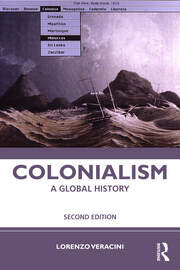
Introduction: Approaching Colonialism 1: Europe’s Expansion – The First and the Second Waves 2: The Atlantic Slave Trade 3: The Mercantilist Colonial Empires 4: Empire by Settlers – The Third Wave 5: The Imperialism of Free Trade – The Fourth Wave 6: The Imperialist Scramble – The Fifth Wave 7: The Last Wave? High Imperialism and Fascist Aggression 8: The Japanese Colonial Empire, 1868–1945 9: Decolonisation: Conceded or Conquered? Conclusion: Colonial Legacies, Underdevelopment, and Postcolonial Violence
Biography
Professor Lorenzo Veracini teaches history and politics at the Swinburne University of Technology, Melbourne (Australia). His research focuses on the comparative history of colonial systems. His recent books include Settler Colonialism: A Theoretical Overview (2010 and 2024), Colonialism: A Global History, (Routledge 2022), and The World Turned Inside Out (2021).
"Exploring different global waves of colonialism, this new edition of Colonialism: A Global History highlights not just the adaptability of colonialism and the dynamics of decolonisation but also its long-lasting impacts on Global South countries. A key text for studying colonialism through a comparative lens."
Professor Henrice Altink, Department of History, University of York
"Updated to embrace ongoing ‘history wars’ and the remarkable geopolitical occurrences of recent years, this is a sweeping, hard hitting survey of colonialism across the ages, offering penetrative analysis and pronounced opinion. It dissects the nature of colonialism and imperialism, supporting sharp analysis with examples drawn from different parts of the world in different ages. Veracini demonstrates that whatever the context, the nature of colonialism changes little, even if its character shape shifts. It is a deeply scholarly and rigorously intellectual work."
Professor Ashley Jackson, King's College London and University of Oxford
"Colonialism: A Global History delivers a powerful and timely examination of colonialism at a moment when old imperial ambitions are resurging, new ones are taking shape, and colonial history itself—its violence and consequences—is fiercely debated. In this compelling and accessible study, Veracini charts colonialism’s evolution across continents and centuries, cutting through its many forms to reveal the global structures and connections that sustain it. He examines its enduring legacies while illuminating both postcolonial and anticolonial struggles. This updated edition is more attentive to Indigenous experiences of colonialism and to the history of intellectual engagement with its ideology. Essential reading for students and scholars alike, this book reshapes how we understand colonialism—past and present."
Professor Magdalena Naum, Department of Archaeology and Ancient History, Lund University
