




1st Edition
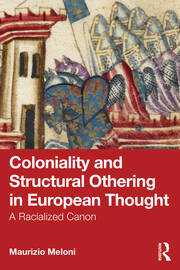
Coloniality and Structural Othering in European Thought A Racialized Canon
1. The European Can(n)on 2. “I hate the entire race” (Odi genus universum). Visceral Aversion to Arabic Sources in Petrarch’s Humanism 3. “And all the world would be called Africa”. Blood, Ethnicity and Whiteness in Petrarch’s Latin epic 4. On the Very Border of Civilization: Evolutionary Theory Meets Genocide 5. The Civilizing Process has a ‘Black History’ 6. Eurocentric, All- Too-Eurocentric: Occidentalism in Foucault’s Genealogy of Modern Governmentality and Biopolitics 7. The Forgotten Extimacy of Italy (Where Eternal Fascism Lurks)
Biography
Maurizio Meloni is Associate Professor of Sociology at the School of Humanities and Social Sciences at Deakin University, Australia. He works at the interface of social theory and the history of biology, racism, and the body. His authored books include: Political Biology (2016), and Impressionable Biologies (Routledge, 2019).
‘An original and erudite study on the ‘eviction’ of indigenous Arabic-Europe from the canons of western culture, this study is a welcome intervention in our times of resurgent Christian and, more generally, religious nationalisms.’
Miguel Vatter, Deakin University, Australia
‘This is an extraordinary and fascinating text that effects a seismic temporal and geographic shift in our understanding of the forms of racialization that have scaffolded European colonialism. With astonishing erudition and deft trans-disciplinary analysis, Meloni shows how late medieval Mediterranean and Italianate efforts to cleanse the European canon and culture of its Arabic constituents gave root to the binaries and grammars of othering that continue to shape the world today. This book is a must-read.’
Samantha Frost, University of Illinois, USA
