





1st Edition
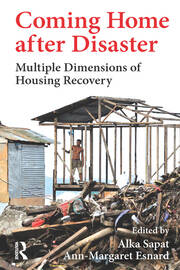
Coming Home after Disaster Multiple Dimensions of Housing Recovery
Section I: Context and Concepts
Chapter 1: Disaster recovery and community renewal: housing approaches
Mary Comerio
Chapter 2: Post Disaster Housing Vulnerability: Getting People Back Home- Brenda Phillips
Chapter 3: Displacement, Relocation and Resettlement: Housing, Home, and Community Considerations
Ann-Margaret Esnard
Chapter 4: Financing Housing Recovery through Hazard Insurance: The Case of the National Flood Insurance Program
Mike Lindell, Wesley Highfield, and Samuel Brody
Chapter 5: The Politics of Disaster Recovery: Policy and Governance Challenges in Post-Disaster Housing
Alka Sapat
Section II: Understanding Housing Recovery in the United States
Chapter 6: The Texas Experience with 2008’s Hurricanes Dolly and Ike
Shannon Van Zandt and Madison Sloan
Chapter 7: Affordable Housing and Disaster Recovery: A Case Study of the 2013 Colorado Floods
Andrew Rumbach & Carrie Makarewicz
Chapter 8: Tornado Housing Recovery
Brenda Phillips & Susamma Seeley
Chapter 9: Housing Recovery after Sandy: A Vignette Study
Ali Nejat, Souparno Ghosh, Zhen Cong & Daan Liang
Chapter 10: Emergency Sheltering and Temporary Housing Issues: Assessing the Disaster Experiences and Preparedness Actions of People with Disabilities to Inform Inclusive Emergency Planning in the United States
Brian Gerber
Section III: Housing Recovery in a Global Context
Chapter 11: Early Post-Disaster Shelter Recovery in Fragile States: A Case of the 12 January 2010 Haiti Earthquake
Emel Ganapati & Guitele Rahill
Chapter 12: Disaster Housing Recovery in Rural India: Lessons from 12 Years of Post-Tsunami Housing Efforts
Sudha Arlikatti and Simon Andrew
Chapter 13: Planning for Housing recovery after the 2008 Wenchuan Earthquake in China
Yang Zhang & William Drake
Chapter 14: Residential Relocation Processes in Coastal Areas: Tacloban City after Typhoon Yolanda
Kanako Iuchi and Elizabeth Maly
Section IV: Multiple Perspectives on Housing Recovery
Chapter 15: Meta-patterns in Post-Disaster Housing Reconstruction and Recovery
Gonzalo Lizarralde, Fayazi Mahmood, Faten Kikano & Isabelle Thomas Maret
Chapter 16: Post-Disaster Reconstruction: Informal Settlers and the Right to Adequate Housing
Jennifer Duyne Barenstein
Chapter 17: Civil Society and Recovery: Non-governmental Organizations and Post-Disaster Housing
Alka Sapat
Chapter 18: Pre- and Post-Disaster Conditions, their Implications, and the Role of Planning for Housing Recovery
Gavin Smith
Chapter 19: Anticipating and Overcoming Regulatory and Legal barriers during Rebuilding and Resettlement
John Marshall, Adrienne La Grange, and Ann-Margaret Esnard
Biography
Alka Sapat is an associate professor of Public Administration at Florida Atlantic University. Her expertise includes disaster and crisis management, vulnerability and resilience assessment, environmental policy governance, environmental justice, and social network analysis.
Ann-Margaret Esnard is a professor of Public Management and Policy in the Andrew Young School of Policy Studies at Georgia State University (GSU). Her expertise encompasses urban planning, disaster planning, hazard and vulnerability assessment, and GIS/spatial analysis. Esnard has been involved in a number of related research initiatives, including National Science Foundation funded projects on topics of population displacement from catastrophic disasters, long-term recovery, and the role of diaspora groups in disasters with transnational impacts.
