




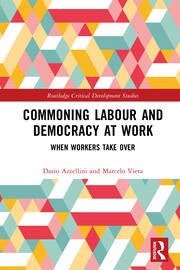
1st Edition
Commoning Labour and Democracy at Work When Workers Take Over
Introduction: Recuperating Workplaces and Community Spaces
Part 1. Setting the Conceptual Stage: Recuperating Productive Life, Democratizing Work
1. Class Still Matters: Autogestión, Living Labour, the Moral Economy of Work, and the Labour Commons
2. A Conceptual Review: Workers’ Self-Management, Workers’ Control, and Autogestión
3. A Historical Perspective: Key Debates in Autogestión
Part 2. Mapping the Experiences of Worker-Recuperated Enterprises in Latin America
4. ‘Occupy, Resist, Produce’: Argentina’s Worker-Recuperated Enterprises Set the Stage
5. Between the Social and Solidarity Economy and the State: Worker-Recuperated Enterprises in Brazil and Uruguay
6. Cooperatives, Co-Management, and Workers’ Councils: Worker-Recuperated Enterprises in Venezuela
Part 3. Mapping the Experiences of Worker-Recuperated Enterprises in Europe and the Rest of the World
7. Labour-Conflict Conversions Amid Wider Cooperative Movements: Worker-Recuperated Enterprises in Italy and France
8. Workers’ Responses to Rising Austerity and Social Challenges: Worker-Recuperated Enterprises in the Rest of Europe
9. Inklings of a Larger Global Movement: Worker-Recuperated Enterprises in the Rest of the World
Part 4. Worker-Recuperated Enterprises as Labour Commons: Contradictions and Possibilities
10. Recuperating the Commons
11. Commonalities in the Lived Experiences of Worker-Recuperated Enterprises
12. The Dual Realities of Worker-Recuperated Enterprises
13. Worker-Recuperated Enterprises and Workplace Democracy as Labour Commons
Biography
Dario Azzellini, PhD in Political Science and in Sociology, is Visiting Research Fellow at the ILR School, Cornell University, USA. Azzellini’s over 20 books, 11 films, and more than 100 journal articles and book chapters focus on labour, self-management, sustainability and just transition, social transformation, and global political economy, many of which have been translated into various languages. He is also the founder of the multilingual website workerscontrol.net. Follow his work at www.azzellini.net
Marcelo Vieta, PhD in Social and Political Thought, is Associate Professor and Chair of the Department of Leadership, Higher and Adult Education and co-director of the Centre for Learning, Social Economy and Work at the Ontario Institute for Studies in Education of the University of Toronto, Canada. He has published award-winning books and dozens of articles and book chapters on workers’ self-management, economic democracy, cooperativism, and the social and solidarity economy. Follow his work at www.vieta.ca
"In this book, commoning comes alive through a comprehensive discussion of workers' and communities' self-management practices around the world. The conventional model of command-and-control management and exploitation is turned upside down, means of existence are reclaimed from the market and the state, and work becomes embedded in the meaningful praxis of collective life—a much-needed ray of light in these dark times."
Massimo de Angelis, University of East London, author of Omnia Sunt Communia
"The world shakes as the US empire and its domestic capitalism decline together, as BRICS rise and Europe falls, and as climate change and artificial intelligence all add up to reorder nearly everything. Most of those who think, teach, and manage workplaces (private and state) mostly continue unperturbed to accept and simply assume the employer vs employee mode of organizing workplaces. This important book joins a growing literature that breaks with all that. Workers can and already have taken over and run workplaces democratically, collectively, and successfully. The theories and empirical records based on those practices are available. This book takes them important steps further. It shows how and why ending the employer–employee organization of workplaces is a necessary part of real solutions to capitalism's accumulated and unmet problems."
Richard D. Wolff, The New School, host of Economic Update
"This book takes us on an exciting journey into the ‘concrete utopia’ of the labour commons, through a remarkable mapping of worker-recuperated enterprises, their features and possibilities across the globe. This concrete utopia suggests novel ways to democratize the productive and reproductive organization of work, centring workers’ self-determination and a more equitable redistribution of economic surpluses. Most importantly, in this analysis the labour commons are not a romantic ideal: they are an arena for and the outcome of struggle. A great read for those concerned with the study of the labour process, workers-centred labour regimes, and labour rights, and for anyone interested in concrete examples of how workers can challenge external labour control and reclaim the fruits of their labour, and their labour autonomy."
Alessandra Mezzadri, SOAS, University of London
"Dario Azzellini and Marcelo Vieta have written a fantastic book. It’s essential reading for anyone concerned with workplace domination, and a vital guide for envisioning a post-neoliberal world."
Tom Malleson, University of Wesern Ontario, author of Against Inequality and After Occupy
