




1st Edition
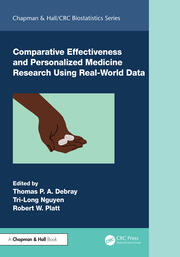
Comparative Effectiveness and Personalized Medicine Research Using Real-World Data
1 Introduction to RWD and RWE for decision making in health care
Amr Makady, Thomas P.A. Debray, and Grammati Sarri
2 Case studies
Christina Read, Jamie Elvidge, Jeremy Dietz, Konstantina Chalkou, and Thomas P.A. Debray
3 Validity control and quality assessment of real-world data and real-world evidence
Elvira D’Andrea and Grammati Sarri
4 Introduction to Directed Acyclic Graphs (DAGs) for bias visualization
Tri-Long Nguyen and Katrine Strandberg-Larsen
5 Understanding and defining causal effects
Tri-Long Nguyen, Jessica L. Rohmann, Tat Thang Vo, Robert W. Platt, and Thomas P.A. Debray
6 Estimands
Marian Mitroiu, Jessica L. Rohmann, Tri-Long Nguyen, Robert W. Platt, and Thomas P.A. Debray
7 Confounding adjustment using propensity score methods
Tammy Jiang, Gabrielle Simoneau, Changyu Shen, Fabio Pellegrini, and Carl de Moor
8 Effect Modification in Non-Randomized Studies
Mohammad Ehsanul Karim
9 Confounding adjustment using prognostic score methods
Tri-Long Nguyen, and Thomas P.A. Debray
10 Dealing with missing data
Johanna Mu˜noz, Hanne Oberman, Gerko Vink, and Thomas P.A. Debray
11 Principles of meta-analysis and indirect treatment comparisons
Thomas P.A. Debray, Natalie Dennis, Dimitris Mavridis, Aur´elie Bardet, and Sofia Dias
12 Systematic review and meta-analysis of Real-World Evidence
Thomas P.A. Debray, Sofia Dias, Stephen Duffield, and Grammati Sarri
13 Individual Participant Data Meta-analysis of clinical trials and real-world data
Pablo Emilio Verde, Tasnim Hamza, Georgia Salanti, Fabio Pellegrini, Orestis Efthimiou, and Thomas P.A. Debray
14 Dealing with irregular and informative visits
Janie Coulombe, Johanna Mu˜noz, Gabrielle Simoneau, Robert W. Platt, and Thomas P.A. Debray
15 Dealing with measurement error
Valentijn de Jong, Timo Brakenhoff, Harlan Campbell, Thomas P.A. Debray, and Paul Gustafson
16 The role of machine learning in real-world evidence generation
Robert W. Platt, Putri W. Novianti, and Rubiya Akter
17 Introduction to methods for personalizing medicine
Jeroen Hoogland, Thomas P.A. Debray, Guillaume Desachy, and Tri-Long Nguyen
18 Modeling Personalized Treatment Effects Using Multiple Data Sources
Orestis Efthimiou, Konstantina Chalkou, Michael Seo, Fabio Pellegrini, Georgia Salanti, and Thomas P.A. Debray
19 Validation of prediction models for patient outcomes and individualized treatment effect
Le Thi Phuong Thao, Orestis Efthimiou, Tibor Varga, Jeroen Hoogland, and Thomas P.A. Debray
20 Visualization and interpretation of individualized treatment rule results
Xiaotong Jiang, Gabrielle Simoneau, Fabio Pellegrini, Changyu Shen, Carl de Moor, and Lu Tian
21 Digital Health in Real-World Data: Challenges and Opportunities
Gabrielle Simoneau, Alf Scotland, Fatta B. Nahab, Shibeshih Belachew, and Carl de Moor
22 RWE in regulatory and reimbursement decision-making
Xavier Kurz, Jeremy Dietz, Dalia Dawoud, and Thomas P.A. Debray
23 Concluding remarks: Putting methods to practice
Thomas P.A. Debray, Guillaume Desachy, Tri-Long Nguyen, and Amr Makady
Biography
Thomas Debray, PhD, is a distinguished statistician and academic who transitioned from academia into specialized consulting for the pharmaceutical industry, leveraging his expertise in real-world evidence, precision medicine, and evidence synthesis to drive innovation in clinical research. He is currently affiliated with the University Medical Center G¨ottingen as a Guest Scientist, where he continues to collaborate on methodological research together with Prof. Tim Friede. He previously served as an Assistant Professor at Utrecht University, and held honorary positions at University College London and the University of Oxford. Furthermore, he served as an Associate Editor for Diagnostic and Prognostic Research, where he played a pivotal role in promoting the dissemination of high-quality prediction modeling research.
During his academic tenure, Dr. Debray collaborated with leading experts such as Prof. Carl Moons, Prof. Richard Riley, and Prof. Ewout Steyerberg to advance meta-analysis methods for risk prediction. He contributed to Cochrane methodological guidelines, led the EU-funded RECODID project on data harmonization, and co-developed the TRIPODCluster reporting guidelines to improve transparency in clustered prediction model studies.
He has also been active within the European Network of Centres for Pharmacoepidemiology and Pharmacovigilance (ENCePP), helping to strengthen methodological standards in pharmacoepidemiology and real-world evidence research. As the founder of Smart Data Analysis and Statistics, Thomas leads a team dedicated to advancing clinical trial methodologies and providing tailored statistical support to pharmaceutical companies and biotech firms. The company focuses on non-standard, innovative approaches to clinical trial design, evidence synthesis, comparative effectiveness research, and simulation-based decision making—methods that go beyond traditional analyses to address complex regulatory and scientific challenges. Through its active role in international research consortia and grants, such as the Marie Sk lodowska-Curie SHARE-CTD initiative on data sharing in clinical trials, SDAS provides a gateway for academia, industry, HTA bodies, and regulators to interact and co-develop innovative solutions.
As the founder of Smart Data Analysis and Statistics, Thomas leads a team dedicated to advancing clinical trial methodologies and providing tailored statistical support to pharmaceutical companies and biotech firms. The company focuses on non-standard, innovative approaches to clinical trial design, evidence synthesis, comparative effectiveness research, and simulation-based decision making—methods that go beyond traditional analyses to address complex regulatory and scientific challenges. Through its active role in international research consortia and grants, such as the Marie Sk lodowska-Curie SHARE-CTD initiative on data sharing in clinical trials, SDAS provides a gateway for academia, ndustry, HTA bodies, and regulators to interact and co-develop innovative solutions.
Long Nguyen, PhD, is an Associate Professor in the Section of Epidemiology at the University of Copenhagen. His research bridges epidemiological and statistical methodologies, focusing on causal inference and prediction modeling with applications in medicine and public health. Dr. Nguyen is committed to science democratization and public engagement through culture and the arts, exemplified by his creation of nor · bro, a novel platform in Copenhagen’s Nørrebro neighborhood that fosters societal reflections through workshops, art exhibitions, and community events.
In his teaching role, Dr. Nguyen leads and contributes to courses at the University of Copenhagen, focusing on themes such as innovative teaching methods, causal inference,
precision medicine, and advanced epidemiological techniques. His dedication to education was recognized with a nomination for the Teacher of the Year Award (˚Arets Harald) in 2023.
Dr. Nguyen’s interdisciplinary approach and commitment to integrating diverse knowledge domains significantly contribute to advancing clinical epidemiology and public health engagement.
Robert Platt, PhD, is Director of the School of Population and Global Health, and holds the Albert Boehringer Chair in Pharmacoepidemiology at McGill University. His research focuses on developing advanced statistical methods for causal inference in observational studies and clinical trial data, with particular emphasis on pharmacoepidemiology, pediatric, and perinatal epidemiology. Prof. Platt is the Principal Investigator of the Canadian Network for Observational Drug Effect Studies (CNODES) and led the CNODES Methods Team from 2011 to 2022. Over its lifespan, CNODES has addressed more than 80 queries from Canadian and international stakeholders on drug safety and effectiveness.
Prof. Platt has authored or co-authored over 400 peer-reviewed articles on statistical methodology and applications. He has supervised more than 50 research trainees in epidemiology,
biostatistics, and statistics, fostering the next generation of researchers in these fields. Dr. Platt has served as President of both the Society for Pediatric and Perinatal Epidemiologic
Research and the Statistical Society of Canada. He is a Fellow of the American Statistical Association and the International Society for Pharmacoepidemiology, recognizing his significant contributions to statistical science and public health research.
In addition to his research and mentorship, Prof. Platt plays a pivotal role in academic publishing. He is an Editor-in-Chief of Statistics in Medicine, an editor for the American Journal of Epidemiology, and an Associate Editor for both the International Journal of Biostatistics and Pharmacoepidemiology and Drug Safety. His leadership and expertise continue to shape the fields of epidemiology and biostatistics globally.
