




1st Edition
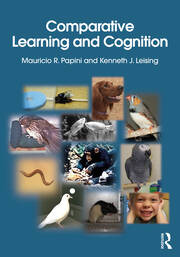
Comparative Learning and Cognition
About the Authors
Part I: Foundations
Chapter 1: Evolution: A context for comparative learning and cognition
1.1 Evidence
Molecular evidence
Embryology
Anatomy
Biogeography
Paleontology
Contemporary evidence
Domestication
2 Natural selection and adaptation
2.1 Logic of natural selection
2.2 Natural selection
Field observations and experiments
2.3 Types of direct fitness
Measuring Lifetime Reproductive Success (LRS)
2.4 Natural selection and diversity
Traits contributing to survival
Correlated traits
Direct fitness and adaptation
2.5 From morphology to behavior
2.6 Sexual selection and the brain
3 Diversity of life
3.1 Taxonomy of life
3.2 Animal phyla
3.3 Ediacaran and Cambrian faunas
3.4 Evolution of chordates
3.5 Hominins
Early hominins
Homo
Archaic humans
Early and recent modern humans
4 Evolution of the vertebrate brain and behavior
4.1 Key innovations of vertebrates
4.2 Agnathan brains
4.3 Regions of the vertebrate brain
Spinal cord
Rhombencephalon and mesencephalon
Diencephalon
4.4 Telencephalon
Subdivisions
Fish telencephalon
Striatum
Limbic system
Origin and evolution of the cortex
4.5 Principles of brain size
Selective breeding for brain size
Relative brain size
Comparative and developmental aspects of encephalization
Brain size and intelligence
Behavioral specializations and the brain
Glossary
References
Chapter 2: Fundamentals of stimulus control
1 Properties of a stimulus
1.1 Evolutionary framework
2 Stimulus control
2.1 Response probability
Reflexes
2.2 Response strength
2.3 Associative learning
Classical (or Pavlovian) conditioning.
Operant (or instrumental) conditioning
Motivational control of operant behavior
Stimulus control of operant behavior
2.4 Generalization and discrimination
3 Stimulus control over other properties of behavior
3.1 What does the behavior look like?
3.2 When does the behavior occur?
3.3 Where does the behavior occur?
4 The nature of the reinforcer
5 Contiguity, contingency, and relative validity
6 Summing up
Glossary
References
Part II: Learning
Chapter 3: Learning in simple systems
1.1 What is a learning phenomenon?
1.2 Levels of mechanistic analysis
1.3 Species similarity in learning phenomena
1.4 Species differences in learning phenomena
2 Invertebrate learning
2.1 Cnidarian neurons
2.2 The nervous systems of bilateral animals
2.3 Properties of habituation
2.4 Habituation in cnidarians
3 Behavioral and neural plasticity in nonassociative learning
3.1 Habituation and dishabituation
3.2 Short-term and long-term habituation
3.3 Neural basis of short-term habituation: C. elegans
3.4 Neural basis of short-term habituation: A. californica
3.5 Neural basis of long-term habituation: C. elegans
3.6 Neural basis of long-term habituation: A. californica
4 Cellular bases of sensitization
4.1 Short-term sensitization
4.2 Dishabituation and short-term sensitization in A. californica
4.3 Long-term sensitization
4.4 Evolution of sensitization in mollusks
4.5 Generality of the neural mechanisms of nonassociative learning
5 Associative learning and cognition in invertebrates
5.1 Associative learning in basal invertebrates
5.2 Associative learning in mollusks
5.3 Associative learning in arthropods
5.4 Learning mutants in fruit flies
5.5 Invertebrate cognition
5.6 Parallel evolution from common cell-molecular mechanisms
6 Behavioral plasticity in aneural organisms
6.1 Some conceptual issues
6.2 Learning in aneural organisms
Bacteria and archaeon
Protists
Plants
Fungi
Basal animal phyla
6.3 What are nervous systems good for?
Glossary
References
Chapter 4: Associative learning: Acquisition
1 Introduction
2 Associative processes
2.1 Contiguity
Contiguity in Pavlovian conditioning
Contiguity in operant conditioning
2.2 Comparative and developmental generality of contiguity
2.3 Learning/performance dichotomy
2.4 What is learned in Pavlovian conditioning?
2.5 What is learned in operant conditioning?
2.6 Hierarchical associations: Occasion setting
2.7 Neurobiology of stimulus contiguity in mammals
Long-term potentiation and depression
From brain slice to behavior
SàS and SàR associations in the brain
3 Acquisition factors
3.1 Beyond contiguity: Salience, magnitude, and temporal factors
3.2 Signalàoutcome relevance
3.3 Signal-context interactions
3.4 Conditioned reinforcement
3.5 Operant contingencies
Positive reinforcement
Punishment
Omission
Escape
Avoidance
4 Inhibitory conditioning
4.1 Summation and retardation tests
Detection issues
Control issues
Reduced generalized excitation
Differential generalization of excitation
Attentional enhancement
Attentional decrement
Contextual blocking
Stimulus generalization decrement
4.2 Neurobiology of inhibitory conditioning
5 Schedules of reinforcement
6 What is a reinforcer?
7 Situational generality of associative learning
7.1 Interoceptive CSs
7.2 Sexual reinforcement
7.3 Conditioned immunomodulation
7.4 Conditioning of allergies
7.5 Drug tolerance
Glossary
References
Chapter 5: Associative learning: Integration
2 Extinction and learning
2.1 Procedure, phenomenon, mechanism
2.2 Unlearning vs. parallel associations
3 Perception and learning
3.1 Compound conditioning
3.2 Overshadowing and blocking effects
3.3 Signal-context interactions
4 Attention and learning
4.1 Latent inhibition
4.2 Comparative studies of latent inhibition
4.3 Intra- vs. extra-dimensional transfer
4.4 Perceptual learning
5 Motivation and learning
5.1 Incentive value
5.2 Wanting and liking
6 Emotion and learning
6.1 Fear/threat
6.2 Neurobiology of fear
Signal and contextual fear
Fear extinction
Consolidation and reconsolidation of fear memories
6.3 Frustration
Aftereffects
Anticipatory effects
Comparative and developmental studies
6.4 Frustration, memory update, and emotional activation
6.5 Neurobiology of fear and frustration in vertebrates
7 Choice and learning
7.1 Matching
7.2 Matching and drug dependence
7.3 Undermatching, overmatching, and maximizing
7.4 Delay discounting
Glossary
References
Chapter 6: Associative learning: Interactions
2 Interactions between elicited and reinforced behaviors
2.1 Equipotentiality
2.2 Misbehavior
2.3 Adjunctive behavior
Brain mechanisms of schedule-induced polydipsia
2.4 A defensive response system
3 Escape and avoidance learning
3.1 Avoidance conditioning
3.2 Escape conditioning
3.3 Neurobiology of avoidance learning
3.4 Learned helplessness
4 Impulsivity and self-control
4.1 The marshmallow test
4.2 Self-control in other animals
4.3 Substance-use disorders and impulsivity
4.4 Neurobiology of substance use disorders
Reward circuitry
Withdrawal symptoms and circuitry
5 Pavlovian control of operant behavior
5.1 Conditioned suppression of operant behavior
5.2 Pavlovian-instrumental transfer
General and specific transfer
Neurobiology of PIT
Relevance of PIT
Glossary
References
Chapter 7: Social learning
1 Introduction
2 From individual to social learning
2.1 Individual recognition
2.2 Kin recognition
2.3 Feeding and social learning
2.4 Predator recognition
2.5 Social reinforcement
2.6 From social reinforcement to reproductive success
2.7 Imitation
3 Imprinting in precocial birds
3.1 Properties
3.2 Motivational factors
3.3 Learning factors
3.4 Neurobiology of imprinting
3.5 Sexual imprinting
3.6 Imprinting-like phenomena in other species
4 Early social learning
4.1 Attachment
4.2 Attachment in primates
4.3 Early social restriction
5 Tool use and culture
6 Teaching
Glossary
References
Part III: Cognition
Chapter 8: Timing behavior
2 Circadian Timing
2.1 Behavioral evidence
2.2 Neurobiology of circadian rhythms
3 Interval Timing
3.1 Scalar timing theory
Time-production tasks
Time-perception tasks
3.2 Oscillators and nonlinear timing
3.3 Time as a stimulus property
Acquisition
Extinction
Postextinction relapse of the CR
Cue competition and integration based on timing
4 Where is timing in models of conditioning?
5 Can nonhuman animals time travel?
Glossary
References
Chapter 9: Spatial behavior
1 Introduction: Spatial behavior
2 Migration and large-scale spatial behavior
3 Small-scale navigation
3.1 Path integration
3.2 Beacon homing
3.3 Route behavior
3.4 Map-like spatial behavior
4 Location as a stimulus property
4.1 Acquisition and extinction
4.2 Generalization and discrimination
4.3 Cue competition
5 Spatial integration
6 Where is location in models of conditioning?
7 Neurobiology of spatial behavior
7.1 Insects
7.2 Mammals
Glossary
References
Chapter 10: Categories, concepts, and numerical competence
1 Conceptual behavior
2 Generalization and discrimination revisited
3 Acquired distinctiveness and equivalence
3.1 Procedures
3.2 Stimulus equivalence and emergent relations
3.3 Real-world applications
4 Multiple-exemplar training
4.1 Perceptual categories
Basic level
Subordinate level
Superordinate level
4.2 Relational categories
4.3 Relation between relations
5 Theories and models of conceptual behavior
5.1 Linear feature models
5.2 Exemplar theory
5.3 Prototype theory
5.4 Neurobiology and neural networks
6 Numerical competence
6.1 Approximate numerical magnitude
6.2 Counting
References
Chapter 11: Communication and language
1 Animal signals
2 Avian vocal learning
2.1 Calls
2.2 Vocal learning
2.3 Age-dependent plasticity
2.4 Dialects
2.5 Age-independent plasticity
2.6 Brain mechanisms avian song learning
Brain circuit
Patterns of gene expression
2.7 From proximate to ultimate causation
3 Referential calls in mammals
4 Human language
4.2 Properties
4.2 Basic functions
4.3 Verbal operants
Intraverbals, mands, and tacts
5 Teaching language to nonhuman animals
5.1 Brief history
5.2 Language production
Hand gestures
Symbols
5.3 Language comprehension
5.4 Language training in nonprimate species
Glossary
References
Biography
Mauricio R. Papini is Professor of Psychology at Texas Christian University, U.S.A.
Kenneth J. Leising is Professor of Psychology at Texas Christian University, U.S.A.
"The book by Papini and Leising constitutes a valuable and comprehensive contribution to the study of the relationship between evolution and behavior across different species. It presents an updated and thorough view of comparative psychology, addressing evolutionary perspectives on learning processes and animal cognition. I highly recommend this book for researchers and students seeking to deepen their understanding of the evolution of biological, psychological, and social aspects related to animal behavior."
Luis Gonzalo de la Casa, professor at Universidad de Sevilla, Seville, Spain
"This book offers a fresh and insightful perspective on comparative learning and cognition, grounding current research within a robust evolutionary framework. Clearly written and highly engaging, it will be an invaluable resource for both graduate seminars and advanced undergraduate courses. I look forward to incorporating it into my teaching."
Suzanne E. MacDonald, professor at York University, Toronto, Canada
"This textbook offers a precise and balanced introduction to learning and cognition across species. By focusing on behavioral mechanisms—such as association, reinforcement, timing, categorization, and communication—and grounding them in neurobiological evidence, it serves as a reliable resource for both students and experts in comparative cognition."
Tetsuro Matsuzawa, primatologist and former director of the Kyoto University Primate Research Institute
"Papini and Leising integrate evolution thoroughly into their updated discussion of animal learning, scaffolding the reader's understanding much like evolutionary processes scaffolded cognition from simple building blocks to more complex processes. This book presents a much needed integrative approach to comparative cognition and is a welcome addition to a sparse selection of comparative texts."
Jennifer Vonk, Professor of Psychology at Oakland University, Rochester, MI, USA
"This is a remarkable book, remarkable for its solid grounding in evolutionary theory, for the breadth of its coverage (from behavioral plasticity in bacteria to language learning in primates), and for the depth of its scholarship, integrating behavioral and neural levels of analysis."
Michael Domjan, The University of Texas at Austin, TX, USA, and Doctorem Honoris Causa, Konrad Lorenz University, Bogotá, Colombia
