





1st Edition
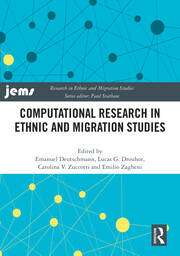
Computational Research in Ethnic and Migration Studies
Introduction – Computational approaches to migration and integration research: promises and challenges
Lucas G. Drouhot, Emanuel Deutschmann, Carolina V. Zuccotti and Emilio Zagheni
Part I: Migration Dynamics
1. Predictive modeling of movements of refugees and internally displaced people: towards a computational framework
Katherine Hoffmann Pham and Miguel Luengo-Oroz
2. Migration networks and the intensity of global migration flows, 1990-2015
Diego F. Leal and Nicolas L. Harder
3. How to model the weather-migration link: a machine-learning approach to variable selection in the Mexico-U.S. context
Mario D. Molina, Nancy Chau, Amanda D. Rodewald and Filiz Garip
Part II: Integration and Intergroup Relations
4. Analyzing community reaction to refugees through text analysis of social media data
Claire Kelling and Burt L. Monroe
5. Catalyst of hate? Ethnic insulting on YouTube in the aftermath of terror attacks in France, Germany and the United Kingdom 2014-2017
Christian Czymara, Stephan Dochow-Sonderhaus, Lucas G. Drouhot, Müge Simsek and Christoph Spörlein
6. Exploring the dynamics of neighborhood ethnic segregation with agent-based modelling: an empirical application to Bradford, UK
Carolina V. Zuccotti, Jan Lorenz, Rocco Paolillo, Alejandra Rodríguez Sánchez and Selamawit Serka
7. Did exposure to asylum seeking migration affect the electoral outcome of the ‘Alternative für Deutschland’ in Berlin? Evidence from the 2019 European elections.
Andrea Petracchin, Lorenzo Gabrielli, Jisu Kim, Sarah Ludwig-Dehm and Steffen Pötzschke
Biography
Emanuel Deutschmann is an Assistant Professor of Sociological Theory at Europa-Universität Flensburg, an Associate at the European University Institute’s Migration Policy Centre, and the author of “Mapping the Transnational World: How We Move and Communicate across Borders, and Why It Matters” (2022).
Lucas G. Drouhot is an Assistant Professor of Sociology at Utrecht University (Netherlands). His core research agenda focuses on immigrant incorporation in Western liberal societies. His past work has appeared in the American Journal of Sociology, the Annual Review of Sociology, Demography, and International Migration Review among other outlets.
Carolina V. Zuccotti is a Marie Skłodowska-Curie Fellow and Visiting Professor at University Carlos III de Madrid (Spain). She specializes in migration, ethnicity, social inequality, and urban studies. Her work has been published in journals like Sociology, International Migration Review, Population, Space and Place, and Ethnic and Racial Studies.
Emilio Zagheni is Director of the Max Planck Institute for Demographic Research. He is best known for his pioneering work on using Web and social media data for studying migration processes and for his role in developing the field of Digital and Computational Demography.
