





1st Edition
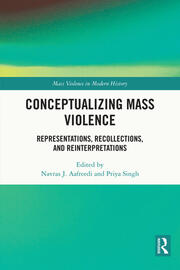
Conceptualizing Mass Violence Representations, Recollections, and Reinterpretations
Introduction
1. Reading Mass Violence
Navras J. Aafreedi and Priya Singh
Part 1: Narratives
2. Violence and Violations: Betrayal Narratives in Atrocity Accounts
Dennis B. Klein
3. Holocaust survivors in Mexico: Intersecting and Conflicting Narratives of Open Doors, Welcoming Society and Personal Hardships
Daniela Gleizer and Yael Siman
4. Historical Narratives, the Perpetuation of Trauma, and the Work of Vamık Volkan
Reuven Firestone
Part 2: Revisionism & Reconstruction
5. Holocaust, Propaganda, and the Distortion of History in the Former Soviet Space
Charles E. Ehrlich
6. The Genocide of 1971 in Bangladesh: Lessons from History
Srimanti Sarkar
7. Holocaust Denial and Minimization in the Indian Urdu Press
Md. Muddassir Quamar
Part 3: Education
8. Holocaust Studies in Australia: Moving from family and community remembrance to human rights and prevention of mass violence
Suzanne D. Rutland and Suzanne Hampel
9. New Developments in Holocaust & Genocide Education in South Africa: : The case study of the Johannesburg Holocaust & Genocide Centre
Tali Nates
10. A Case of Naive Normalization? India's Misbeliefs about Hitler and Schooling on the Holocaust
Anubhav Roy
11. Holocaust Education in India and its Challenges
Navras J. Aafreedi
Part 4: Reflections
12. Sonderkommando Photo 4 and the Portrayal of the Invisible
David Patterson
13. Overcoming "Intimate Hatreds:" Reflections on Violence against Yazidis
Güneş Murat Tezcür and Tutku Ayhan
14. The State and its Margins: Changing Notions of Marginality in Turkey
Anita Sengupta
Part 5: Trauma
15. Pinochet's Dictatorship and Reflections on Trauma in Chile: How much have we learned in terms of human rights?
Nancy Nicholls Lopeandía
Part 6: Memorialization
16. ‘Grassroots’ Holocaust Museums: Revealing Untold Stories
Stephanie Shosh Rotem
17. Fabric, Food, Song: The Quiet Continuities in Bengali Life Seventy Years After Partition
Rituparna Roy
Part 7: Literature
18. The Failure of Secular Publics and the Rise of the Jewish Religious Public in Nathan Englander’s For the Relief of Unbearable Urges
Fuzail Asar Siddiqi
Part 8: Dialogue & Reconciliation
19. The 2002 Alexandria Summit and Its Follow Up
David Rosen
Biography
Navras J. Aafreedi is Assistant Professor of History at Presidency University, Kolkata, and Research Fellow at the Institute for the Study of Global Antisemitism and Policy, New York. His publications include his monograph Jews, Judaizing Movements and the Traditions of Israelite Descent in South Asia.
Priya Singh is Associate Director at Asia in Global Affairs (www.asiaingloblaffairs.in). Priya is a political scientist with an interest in issues pertaining to geo-politics, nationalism, post-nationalism, identity, state formation and gender. She has authored, edited and co-edited books on Israel and the Middle East.
