





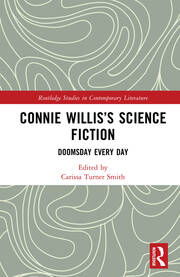
1st Edition
Connie Willis’s Science Fiction Doomsday Every Day
Introduction
PART I: Contagion
Chapter One: All This Has Happened Before, and All This Will Happen Again: Doomsday Book and Recurring Pandemics
Joelle L. Renstrom
Chapter Two: Flip Passes: Interpreting Agency and Contagion in Bellwether
Jill Marie Treftz
PART II: Individual and Collective Trauma
Chapter Three: Emergency Unpreparedness: Responses to Disaster in Connie Willis’s Passage Matthew Newcomb
Chapter Four: Taking it Personally: Private Engagement with Public Trauma from World War II to J.F.K.
Janet L. Bland
PART III: Incarnation and Embodiment
Chapter Five: "You Were Here All Along": Doomsday Book and the Bodies of Christ
Chad Schrock
Chapter Six: Christmas Every Day: Incarnational Theology in Connie Willis’s "Inn" and "Epiphany"
Erin Newcomb
PART IV: Intertextuality
Chapter Seven: Bell Speech in John Donne, Richard Wilbur, and Connie Willis’s Doomsday Book
William Tate
Chapter Eight: Finding Love (and Truth?) in the Midst of Chaos: The Influence of Dorothy L. Sayers’s Detective Fiction on To Say Nothing of the Dog
Christine A. Colón
PART V: Genre, Gender, and Xenophobia
Chapter Nine: The Mote in the Jester’s Eye: Aspects of Race and Gender in Connie Willis’s Light Short Fiction
Sylvia Kelso
Chapter Ten: "Tell All the Truth but Tell it Slant": Rhetorical Humor in Connie Willis’s Short Fiction
Rosalyn Eves
PART VI: Humanist and Posthumanist Witness
Chapter Eleven: Messages in a Bottle: The Historian’s Ethic in Connie Willis’s Quantum Universe
Kathryn N. McDaniel
Chapter Twelve: Schrödinger’s Cathedrals: Humanist Memory and Posthumanist Sacramentality in Connie Willis’s Fiction
Carissa Turner Smith
Biography
Carissa Turner Smith is Professor of English and Writing Center Director at Charleston Southern University, where she teaches American literature. Her book Cyborg Saints: Religion and Posthumanism in Middle Grade and Young Adult Fiction was published by Routledge in 2020.
