
1st Edition

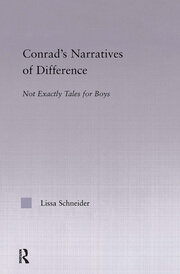
Conrad's Narratives of Difference Not Exactly Tales for Boys

By Lissa Schneider Copyright 2003
175 Pages
by Routledge

175 Pages
by Routledge

175 Pages
by Routledge

In Joseph Conrad’s tales, representations of women and of "feminine" generic forms like the romance are often present in fugitive ways. Conrad’s use of allegorical feminine imagery, fleet or deferred introductions of female characters, and hybrid generic structures that combine features of "masculine" tales of adventure and intrigue and "feminine" dramas of love or domesticity are among the... Read more
Introduction: Not Exactly Tales for Boys  1. Iconography and the Feminine Ideal: Torches, Blindfolds, and the "true light of femininity" in Heart of Darkness, Lord Jim, The Rescue, and "The Return"  2. Plots and Performance: Conrad's "tricks with girls" in "Freya of the Seven Isles," Under Western Eyes, An Outcast of the Islands, and The Rescue  3. Colonial Occupations: Race and Gender in "An Outpost of Progress" and The Nigger of the "Narcissus"  4. Politics in the House: Genre, Narrative, and the Domestic Drama in The Secret Agent, Heart of Darkness, and Lord Jim  Coda: Narrative, Femininity, Death

Biography

Lissa Schneider-Rebozo is Associate Professor of English and Director of Undergraduate Research, Scholarly, and Creative Activity at University of Wisconsin, River Falls, USA.

Honorable Mention, 2005, for the Adam Gillon Book Prize.

'Schneider offers original readings of a number of Conrad’s works. Her thesis—that Conrad challenges hierarchical power in ‘fugitive ways’ through his depictions of difference, particularly gender--is a bold one since it contradicts the critical commonplaces that Conrad was a social conservative and a misogynist. Schneider makes a compelling case, one likely to prompt even the most traditional Conradians to reconsider their assumptions about Conrad and his work.' -Tom Henthorne, Studies in the Novel

'The frequently quoted letters between Conrad and Garnett concerning Conrad’s intentions and methods are fascinating, and the book’s best feature, along with a clear direct approach.' -Lorrie Clark, English Literature in Transition, 1880-1920, Vol. 48, Num. 4
