




1st Edition
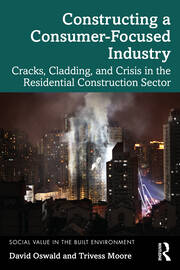
Constructing a Consumer-Focused Industry Cracks, Cladding and Crisis in the Residential Construction Sector
1. Cracks, cladding and crisis in the residential sector, 2. Building defects: considering the human cost, 3. Homeowner vulnerability: dangerous defects, 4. The real cost? Well-being implications for the consumer, 5. Corporate social responsibility for the consumer, 6. Dealing with dangerous defects in multiple occupancy developments, 7. Navigating landlord-tenant conflicts, 8. Government support during times of crisis, 9. Designing and building better for the housing consumer, 10. Conclusions
Biography
Dr. David Oswald is a Senior Lecturer and Deputy Program Manager in the School of Property, Construction and Project Management at RMIT University in Australia. He is a journal editor, reviewer, and PhD examiner and has written multiple award-winning academic publications within construction and the built environment. His recent combustible cladding research with Dr. Moore was used in Victorian parliament (Australia) to demonstrate the need for improving homeowner consumer protection.
Dr. Trivess Moore is a Senior Lecturer in the School of Property, Construction and Project Management at RMIT University in Australia. His research relates to housing quality and performance and focuses on the intersection between technical performance, liveability, social impact, and policy. In addition to recent work with Dr. Oswald on combustible cladding, he has been undertaking research looking at retrofit and the circular economy in Australia.
"The implications of this book are profound. The authors argue for strengthening consumer protection. From my perspective, dangerous defects arise from poor regulation or poor exercise of regulated powers on industry practices, design and materials. This rich and challenging research by Oswald and Moore demonstrates the need to build well and the wider consequences of not doing so. The book deserves to be read and discussed widely within industry, government, and civil society. It can help to initiate change by understanding the social and economic costs to society of dangerous defects. The nature of these changes implies a radical rethink is needed: clarity on oversight and monitoring, responsibilities, regulation, enforcement, and recourse/resolution when things go wrong." Kay Saville-Smith (CRESA, Aotearoa NZ) in Buildings & Cities Journal
