




1st Edition
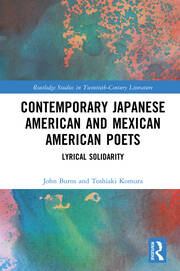
Contemporary Japanese American and Mexican American Poets Lyrical Solidarity
Acknowledgments
Introduction The Intersecting Tales of Japanese American and Mexican American Poetry, the History and the Concepts
Chapter 1 The “Origins” of Japanese American and Mexican American Poetry: Rodolfo “Corky” Gonzales and Toyo Suyemoto as Case Studies of Retrospective Literary Construction
Chapter 2 Creating an Archive: What They Carried and Where They Went
Chapter 3 Collective Haunting: The Entanglement of Law and Trauma in the Poetry of Mitsuye Yamada, Cherríe Moraga, and the Generation of This Bridge Called My Back
Chapter 4 Other Fronts in the Culture Wars: The Poetry of Ana Castillo and David Mura
Chapter 5 The Indeterminate Gazes of Columbus, Cortés, and Genji in the Poetry of Ariana Brown and Kimiko Hahn
Chapter 6 Landscapes, Animals, the Environment: Tortured Nature Imagery of Japanese American and Mexican American Poetry
Works Cited
Index
Biography
John Burns is Associate Professor of Spanish at Bard College. His first monograph, Contemporary Hispanic Poets: Cultural Production in the Global, Digital Age, takes a cultural studies approach to contemporary poetry.
Toshiaki Komura is Professor of English at Meiji Gakuin University in Tokyo. His first monograph, Lost Loss in American Elegiac Poetry: Tracing Inaccessible Grief from Stevens to Post 9/11, examines a difficult to articulate sense of loss and dispossession in modern and contemporary U.S. elegiac poetry through neo-formalist textual analysis, psychoanalytic approaches, and genre history.
