




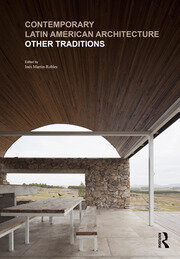
1st Edition
Contemporary Latin American Architecture Other Traditions
Forewords
Specific Particulars: Continental Reasons
Martín Cobas
Memory as a Verb: Architecture as an Act of Remembering.
Julian Bonder
Introduction: Other Traditions
Inés Martín-Robles
PART I. Radical Urbanity
1. To Do a Lot With Very Little: Revisiting the work of Juan Ángel Casasco and its influence on the production of AToT.
Lucia Hollman and Agustín Moscato
2. Background Noise: Colombian Architecture of the 20th Century Related to The Work of Plan:b Architects.
Felipe Mesa
3. Shared Time: Gustavo Scheps, a Travel Companion.
Marcelo Gualano
4. Color Choreography: Matter, Light, and Transit in Mexican Architecture.
Ignacio Mendaro and Pía Mendaro
PART II. Fragile Informality
5. Ecosystems of Proximity: Taller E and Its Influence over Paraguayan Contemporary Architecture.
Emmerick Braun and Miky González Merlo
6. Rooted in Climate, Guided by Nature: Bioclimatic Traditional and Contemporary Practices in Costa Rica
Benjamín García Saxe
7. Interwoven Traditions: The Legacy of Rother, Castro, and Martínez Sanabria.
Antonio Yemail
PART III. Social Participation
8. Thought Construction: Carlos Mijares Bracho – Architect of Foundational Principles.
Mauricio Rocha
9. Memory Excercises: From a Phenomenological Approach to Cultural Imaginaries.
Rubén Muñoz Rodríguez
10. Tales Out of the Unconscious: Pedagogy, Methodology, and Participation in Ecuadorian Architecture Since the 1980s
Pascual Gangotena, David Barragán, Marialuisa Borja, and Esteban Benavides
11. Architecture as a Collective Act: Memory, Territory, and Public Life in the Work of Colectivo C733
José Amozurrutia, Gabriela Carrillo, Israel Espín, Eric Valdez, and Carlos Facio
PART IV. Cultural Cannibalism
12. Transition Architecture: Ítala Fulvia Villa’s Local Interpretation of the Modern Material Legacy
Gabriel Monteleone, Gastón Noriega, and Magdalena Tagliabue
13. Three Peruvian Masters: David Mutal’s Architecture Through the Influence of Juvenal Baracco, Emilio Soyer, and Miguel Rodrigo Mazuré
David Mutal
14. Fragments, Cycles, and Learnings: Shared Works Between Julio Vilamajó, Román Fresnedo Siri, and UZ:AA Architects
Daniella Urrutia and Constance Zurmendi
15.Tropical Meditations: Hybrid Propositions between the Spanish Grid and the American Highway.
Francisco J. Rodríguez- Suárez
Biography
Inés Martín Robles, PhD., is an architect, author and academic. Martín-Robles is an Associate Professor at the University of Virginia School of Architecture. Her research focuses on Modern Spanish and Ibero-American architecture, the survival of the past through tradition, and the role of memory for architectural design methodology. Martín-Robles is a registered architect in Spain and has been practicing architecture for over 25 years. Her work has been featured in over 60 international publications.
“The scholarship demonstrated in this book is outstanding, presenting a sophisticated understanding of both international architectural discourse and local traditions. By prioritizing practitioner voices, the book contributes meaningfully to the conversation about practice-based knowledge in architectural scholarship. By focusing on overlooked lineages and by grounding the analysis in local contexts and perspectives, the book offers a fresh perspective on Latin American architecture.”
Luis Rico Gutiérrez. Dean and Professor, College of Design Iowa State University.
“Inés Martín-Robles book expands our perspectives on Latin American architecture by uncovering overlooked lineages and fostering cross-country dialogues among contemporary architects. It challenges traditional narratives by highlighting diverse influences and lesser-known figures, providing an intergenerational and non-monolithic view of the region’s architectural evolution. An essential read for those interested in expanding the understanding of Global South architectural production beyond the canon.”
Jose Castillo. Chair of the Department of Architecture at Cornell's College of Architecture, Art, and Planning and founding principal of a|911, Mexico.
“Professor Inés Martín Robles curates a compelling collection of original texts by practitioners who, through lived experience, everyday practice, and shared memories, are shaping the contemporary architectural and urbanistic cultural traditions in the continent. Situating these distinct practices and discourses, Martin Robles contributes a compelling conceptual framework that reveals common threads and nuanced local specificities, reclaims overlooked contributions, and expands the inherited canonical narratives.” María Arquero de Alarcón. Professor of Architecture and Urban and Regional Planning, Taubman College, University of Michigan. Co-curator XIII Ibero-American Biennial of Architecture.
“This publication provides a significant and timely contribution to the dissemination of Latin American architecture within English-speaking countries, seeking to elevate the visibility and recognition of the region’s rich, diverse, and frequently underrepresented architectural output, while promoting a deeper understanding of its cultural, social, and environmental dimensions. One of its strengths lies in its in-depth focus on a new generation of architects with limited international exposure but whose practices hold substantial regional significance.”
Gustavo Luis Moré. Principal and founder Moré Arquitectos. Editor, Archivos de Arquitectura Antillana, Dominican Republic.
