





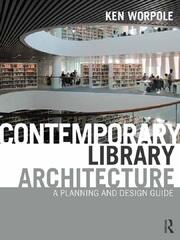
1st Edition
Contemporary Library Architecture A Planning and Design Guide
Part 1: The Library in the City 1. A City with a Great Library is a Great City Part 2: The Libraryness of Libraries 2. Libraries: The 'Sacred' Spaces of Modernity 3. What you see is what you get? Key Aspects of Library 4. A New Wave of Library Architecture Part 3: Planning and Design Processes 5. Developing the Brief and Establishing a Project Management Team 6. Places and Partners 7. Programme and People: The Changing Library Programme 8. A Vital Space for Children and Young People Part 4: Case Studies 9. Public Library Case Studies Barcelona; Bournemouth; Brighton; Canada Water; Cardiff; Dagenham; Ewell; Glasgow Bridge; hook; Huntingdon; Newcastle; Norwich; Whitechapel; Winchester 10. Academic Library Case Studies Aberdeen University; Cranfield University; Sheffield University, Commons; Sheffield University, Western Library; Surrey University Part 5: Lessons for the Future 11. Lessons from the Case Studies and Post-Occupancy Evaluation 12. 21st Century Libraries: Changing Forms, Changing Functions
Biography
Ken Worpole is Emeritus Professor at the Cities Institute, London Metropolitan University, and adviser on public policy to the UK government, the Commission for Architecture and the Built Environment, and the Heritage Lottery Fund. He is also the author of many books and studies on architecture, landscape and urban design. The Independent newspaper wrote that ‘for many years Ken Worpole has been one of the shrewdest and sharpest observers of the English social landscape.'
"It will find an enthusiastic audience among architectural practices (and students) and maybe even more so among librarians faced with the challenge of a new building. The author’s enthusiasm for his subject is clear – he loves libraries and wants his readers to love them too. There can surely be no better starting point when planning a new library." — Catherine Tranmer, Formerly Architecture & Planning Librarian, Oxford Brookes University
"This book is well-presented and richly illustrated with appropriate photographs and plans, and supplies a useful bibliography. It will find an enthusiastic audience among architectural practices (and students) and maybe even more so among librarians faced with the challenge of a new building. The author's enthusiasm for his subject is clear - he loves libraries and wants his readers to love them too. There can surely be no better starting point when planning a library." — ARCLIB, November 2013
