





1st Edition
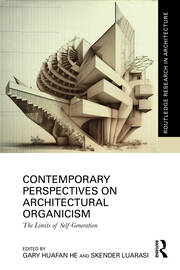
Contemporary Perspectives on Architectural Organicism The Limits of Self-Generation
List of Contributors
Foreword by Mark Jarzombek
Skender Luarasi & Gary Huafan He, Introduction
Section I – Organic and Modern
- Mark Antliff, "Cubism, the Decorative and the Contradictions of Modernism"
- Tim Benton, "The Organic Paradox: Nature and the Machine"
- Anna Bokov, "The Social Organism: Organization of Forms and Forms of Organization in Soviet Architecture"
- Skender Luarasi, "In What Style Should We Build?" Today: Style as World-Crust
- Michael Schlabs, "Songs of Art as Experience: John Dewey’s ‘Vegetable Eye’"
- Eran Neuman, "Bruno Zevi and the Ethics of Organic Architecture"
- Kaz Yoneda, "Japan Re-Natured: Unending Manifesto"
- Ginger Nolan, "Big Data, Smart Village: Organicism and the Rearrangement of Risk"
- Rachel Armstrong, "Electron Flow as "Life’s" Matrix: An Implementable Materiality for Organicism via ‘Living’ Architecture"
- Jacob Wamberg, "Posthuman Reboot: Entropy into Art"
- Wahida Khandker and Tim Flanagan, "On Ephemeral Structures"
- Gary Huafan He, "Modern Architecture and the Organic Pessimism of the Young Lukács"
- Bohang Chen, "A Critique of Organicism in Current Philosophy of Biology"
Section II – The De-Ontology of Systems
Index
Biography
Gary Huafan He is a scholar and architect currently residing in Hangzhou, China. He received his PhD from Yale University Graduate School of Arts and Sciences and School of Architecture in 2020. His primary research focuses on the intersection of architecture and theories of modernity, with particular interest in forms of naturality, culture, class, and social identity in nineteenth- and twentieth-century Europe and the United States. He has co-edited the collection of essays Nature as Ornament (Yale University Press, 2020), and his scholarship has appeared in the Journal of Architecture, arq: Architectural Research Quarterly, and the Journal of the Society of Architectural Historians. He is a licensed architect with a professional BArch degree from Cornell University and has previously taught at Cornell University, Yale University, and the China Academy of Art. He is currently a researcher and assistant professor at Zhejiang University School of Art and Archaeology.
Skender Luarasi is a licensed architect, educator, and writer. His PhD, received at Yale in 2018, focuses on how design processes end and how such question intersects with style, geometry, and parametricism in history. He has published in Future Anterior, Log, Bitácora Arquitectura, Haecceity, and Forum A+P, among others, and has contributed in The Past is Unpredictable: Untimely Interrogations into Architecture (Transcript, 2022). He has co-authored Finding San Carlino: Collected Perspectives on Geometry and the Baroque (Routledge, 2019). He is also the author of Survival through Architecture: A Survey and Analysis of the Architectural Oeuvre of Skënder Kristo Luarasi, 1908–1976 (TU Graz, 2023). He holds an MArch from MIT and a BArch from Wentworth Institute of Technology. He is currently the dean of the Faculty of Research and Development at Polis University in Tirana, Albania. He has previously taught at the RISD, Yale, UMass Amherst, WSU, and MIT. His design practice is based in Boston and Tirana.
