





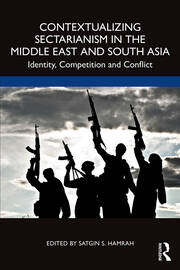
1st Edition
Contextualizing Sectarianism in the Middle East and South Asia Identity, Competition and Conflict
Introduction: Untangling the Complexities of Sectarianism and Moving Beyond Misconceptions
Satgin Hamrah
1. Unravelling Sectarianism in South Asia
Ayesha Jalal
2. The Ahmadiyya Muslim Community’s Identity as the “True Islam” through its Exclusion
Misbah Hyder
3. Understanding the Long-term Impact of Mobilizing Militant Islamists in the Soviet-Afghan War: Strategies of the United States, Saudi Arabia and Iran
Satgin Hamrah
4. Advice Columnists in Egypt: Envisioning the Good Life in an Era of Extremism
Andrea B. Rugh
5. Sectarianism’s Ambiguity: Lebanon as a Case Study, 1843-1958
Brittney Giardina
6. Falling Together: Identity and the Military in Fragmented Societies
Dylan Maguire
7. Accidentally Accelerating Sectarianism: Elections and the U.S. Role in the Iraqi Civil War
Frank Sobchak
8. Contextualization of Sectarian Conflict and Violence in Iraq: The Intersection of Identity, Power and Conflict
Satgin Hamrah
9. Sectarianism and Counterterrorism: Explaining the “Silent Space” between Policy and Practice
Heidi Lane
10. Old Stately Friends, New Sectarian Foes: The Modern Saudi-Iranian Roots in Shia-Sunni Sectarianism
Pouya Alimagham
Conclusion: The Contextualization of Sectarianism: The Role of Identity, Money and Competition
Ibrahim Warde
Biography
Satgin Hamrah is a PhD Candidate in History at Tufts University, where she focuses on the Middle East, South Asia, the Iran-Iraq War, sectarianism, and Islamism, as well as state and non-state conflict and violence. She also focuses on the intersection of identity, memory, trauma and politics on local and transnational levels within the framework of her research interests. Hamrah has a Master of Arts degree in International Relations from Boston University, where her thesis focused on offensive strategies to protect critical infrastructure against terrorism. Hamrah also has a Master of Public Administration degree from the University of Southern California, with a focus on international development and state formation of post-Soviet states in the Caspian region during the 1990s with a focus on Azerbaijan. Hamrah was a Doctoral Fellow at The Fares Center for Eastern Mediterranean Studies at the Fletcher School of Law & Diplomacy at Tufts University between September 2016 and October 2018. She is the founder of the Iran-Iraq War Project.
