





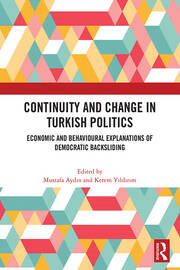
1st Edition
Continuity and Change in Turkish Politics Economic and Behavioural Explanations of Democratic Backsliding
Introduction
Mustafa Aydin and Kerem Yıldırım
1. Elections and partisanship: Analyzing the results of the 2023 general elections in Turkey
Gülnur Kocapınar and Ersin Kalaycıoğlu
2. The 2023 Turkish election: A tale of two campaigns and the duel of populisms
Şebnem Yardımcı-Geyikçi and Hakan Yavuzyilmaz
3. How incumbents create uneven patterns of competition during autocratization: The AKP case of Turkey
Pelin Ayan Musil
4. Right-wing populism in Turkey and the 2023 elections
Ezgi Elçi
5. Difficult choices: Choosing the candidate of the nation alliance in the 2023 Turkish presidential election
Lemi Baruh and Ali Çarkoğlu
6. Ideological linkages and party competition in the 2023 Turkish general elections
Kerem Yıldırım
7. Economic voting in the 2023 Turkish general election
Selim Erdem Aytaç
8. Governance crises and resilience of authoritarian populism: 2023 Turkish elections from the perspective of Hirschman’s ‘exit, voice, and loyalty’
Mustafa Kutlay and Ziya Öniş
9. Erosion of economic institutions in the age of democratic backsliding: an analysis of the Turkish case
Işik D. Özel
10. Politics of household indebtedness in Turkey
Berkay Ayhan, Mustafa Aydin and Ahmet Ulcay
Biography
Mustafa Aydın is Professor of International Relations at Kadir Has University (Istanbul), the President of the International Relations Council of Turkey, and the Coordinator of the Global Academy. He is a member of the European Leadership Network, the Greek Turkish Forum, and the European Academy of Art and Sciences. His areas of interest include international politics, foreign policy analysis, geopolitics of Eurasia, and Turkish politics and foreign policy.
Kerem Yıldırım is currently an assistant professor of political science at Bilkent University, Ankara, Turkey. He received his PhD from Koç University, Istanbul, Turkey, in 2016. He previously taught at Kadir Has and Sabancı Universities in Istanbul. He was a postdoctoral associate in 2019– 2021 at Duke University, Durham, North Carolina, USA. His research interests include party– voter linkages, accountability, party competition, and political communication. His publications appeared in journals such as Political Communication, Political Behavior, Democratization, International Journal of Press/ Politics, Turkish Studies, South European Society and Politics, British Journal of Middle Eastern Studies. He worked on issues such as varieties of political linkages, clientelism, political competition, and Turkish politics.
