




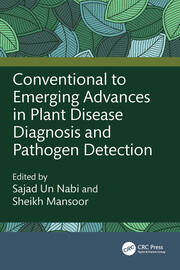
1st Edition
Conventional to Emerging Advances in Plant Disease Diagnosis and Pathogen Detection
1 Plant Disease Diagnosis-Past, Present and Future
Aadil Ayaz, Sajad Un Nabi, Sheikh Mansoor, Mahendra K Verma, Wasim H Raja, Susheel Kumar Sharma and V. K. Braranwal
2 Microscopy as a tool for the detection of Plant Pathogens
Zohra Shabir, Sajad Un Nabi, Mir Mehreen, Sheikh Mansoor
3 Immunodiagnostics: From traditional to recent advances in plant virus detection
Aniket Angira, Tripti Singhal, Manoj Kumar Singh, Sunny Dhir, Vanita Chandel
4 Molecular Diagnostics with a Special Focus on PCR-Based Approaches for The Detection of Plant Pathogens
Uzma Rashid, Sajad u Nabi, Mohammad Irfan, Subaya Manzoor, Sheikh Mansoor
5 Droplet Digital PCR in Fungal Pathogen Detection
Mohammad Irfan, Uzma Rashid, Javid Iqbal Mir, Diaa Abd El Moneim
6 Molecular PLANT-Dx System for Point-of-Use Detection of Pathogens associated with Plant disease
Subaya Manzoor, Sajad Un Nabi, Tariq Rasool Rather, Farooq Ahmad Bhat, Zahoor Ahmad Mir, Shugufta Parveen, Uzma Rashid and Sheikh Mansoor
7 DNA Microarrays as a versatile tool for the detection of plant pathogens
Falak Fayaz, Mohammad Waris Haider
8 Applications of robust isothermal amplification assays in the detection of fungal and viral plant pathogens
Mailem Yazing Shimray, Abnish Kumar, Utkarsh Singh Chauhan, Pooja Bhardwaj, Nishant, Nishant Srivastava, Rakesh Kumar, Susheel Kumar Sharma, Virendra Kumar Baranwal, Deeksha Joshi, Nitika Gupta
9 Next Generation Sequencing Approaches: Detection of Plant Pathogens with a Special Focus on Exploring Plant Virome
Naorem Loya Mangang, Pooja Bhardwaj, Pooja Thapa, Nishant Srivastava, Damini Diksha, Yazing S. Mailem, Nitika Gupta, Sajad U. Nabi, Virendra K. Baranwal and Susheel Kumar Sharma
10 LabonChip Platform for field-based diagnosis of plant pathogens
Devendra Kumar Choudhary, Sunil Kumar Sunani
11 Potential Use of Biosensors in Rapid Detection and Quantification of Pathogens Associated with Plant Disease
Pankhuri Singhal, Marimuthu Elangovan
12 Applications of versatile CRISPR technology for the detection of targeted plant pathogen
Rashmi ER, Reena Prusty, Jyoti priya, Kavitha R, Supreetha B G
13 High throughput phenomics and artificial intelligence in plant disease diagnosis
Shugufta Parveen, Sajad Un Nabi, Zarka Nabi, Fayaz. A. Mohiddin, Muhammad Ashraf Bhat, Subaya Manzoor and Sheikh Mansoor
14 Artificial intelligence techniques in disease diagnosis
Ronit Jaiswal, Sajad Un Nabi, Girish Kumar Jha, Mahendra Kumar Verma, Rajeev Ranjan Kumar
15 Applications of Nanotechnology for Rapid Detection of Plant Pathogens
Ravpreet Kaur, Nitika Gupta and Deeksha Joshi
Biography
Dr Sajad Un Nabi, (ARS, Ph.D), is working as scientist plant pathology at ICAR-Central institute of temperate horticulture Srinagar J&K, India. He completed his PhD in 2020 on apple viruses from ICAR-Indian Agricultural research institute, New Delhi India. He is a Life member of Indian Phytopathological Society, Indian Virological society, world society of virology and honorary life member of Asian PGPR Society. He has published more than 10.0 research publications including research papers, review papers, popular articles, books, book chapters, bulletins and pamphlets in nationally and internationally reputed journals and books. He has submitted more than 100 nucleotide sequences of plant pathogens to Genbank. He is the Recipient of IARI Gold Medal for outstanding academic performance in M.Sc degree, M.J.Narshiman medal from Indian Phytopathological Society for best paper, Young Achiever Award from Agricultural Technology Development Society, Excellence in Plant Pathology Award by International Association of Research and Development Organization (IARDO). He has identified the new potential vector “Hishimonus phycitis (Distant), for sesame phyllody phytoplasma in India, developed Trichoderma harzianum enriched vermicompost in the form of vermi balls and bars for management of soil borne diseases especially chilli wilt. He is presently working on apple cankers and temperate fruit viruses. He has identified new species Diplodia bulgarica in India associated with canker disease of apple. He first time characterized the species spectrum associated with apple canker disease in India. In temperate fruit viruses, he has identified new virus ApNMV and viroid AHVd associated with apple mosaic disease in India. He also confirmed the etiology of apple mosaic disease in India using RNA-Sequencing (RNA-Seq). He also developed multiplexing technique for simultaneous detection of four apple viruses viz., ApMV, ApNMV, ASPV and ASGV for indexing and production of quality virus free planting material. He has also optimized tissue and season for early and rapid detection of apple latent viruses viz., ASGV and ASPV. He is presently involved in understanding the mechanism of mosaic and necrosis development in apple using transcriptome analysis, Virome of stone fruits for developing easy diagnostics. He is also involved in developing scab resistant apple varieties for which two scab resistant apple hybrids has already been registered in NBPGR for national release. He is also involved in extension programmes on management of temperate fruit diseases by conducting trainings, TV talks and consultancies.
Dr. Sheikh Mansoor currently serves as a postdoctoral researcher at the Phenomics Laboratory within Jeju National University in South Korea. His primary research focuses on high-throughput phenomics, remote sensing and precision agriculture. Prior to this role, he held positions as a Postdoc Research Associate at SKIMS Srinagar and as a Project Associate-I at CSIR-Indian Institute of Integrative Medicine Jammu (IIIM). Throughout his academic journey, Dr. Mansoor has had the opportunity to work in reputed laboratories, including the Transcriptomics Labs at SKUAST Kashmir and the Department of Biotechnology and Pathology at Central Institute of Temperate Horticulture (CITH) Rangreth Srinagar. His educational background comprises a BSc degree from SP College of Science (University of Kashmir), an MSc degree from HNBGU Uttarakhand, and a Ph.D. degree from Sher-e-Kashmir University of Agricultural Sciences and Technology of Jammu. Dr. Mansoor has been dedicated to contributing significantly to his field and has displayed a strong commitment to becoming a highly accomplished scientist. His expertise spans various areas, including biochemistry, molecular biology, and genetics. Dr. Mansoor's accomplishments are notable, including over more than 50 research and review papers published in esteemed journals such as Frontiers, Plos One, Scientific Reports, Journal of Fungi (JoF), Planta, Chemosphere, JEMA and Molecules etc. He has also authored 5 books and more than ten book chapters, and holds credit for filing two patent applications. He has showcased his knowledge through guest lectures on topics like sequence assembly, alignment, submission tools, and phylogenetic analysis. He has received practical training in advanced techniques in modern biology and related fields. Dr. Mansoor has been recognized with numerous national and international accolades, including prestigious awards such as Best Thesis, Young Scientist, and recognition for his exceptional oral and poster presentations. He holds membership in a significant big grant (BIRAC) awarded by the Department of Biotechnology (DBT) in India. In addition to his accomplishments, Dr. Mansoor plays an active role as a Review Editor for Frontiers in Ethnopharmacology, and he also contributes as a reviewer for esteemed journals like 3 Biotech, Cell Reports, Frontiers, Plos One, and JARMAP. His unwavering dedication, profound expertise, and active involvement underscore his unwavering commitment to advancing scientific knowledge in his field.
