





1st Edition
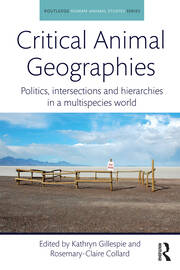
Critical Animal Geographies Politics, intersections and hierarchies in a multispecies world
Chapter 1. Introduction, Rosemary-Claire Collard and Kathryn Gillespie PART I: POLITICS Chapter 2. Animal geographies, anarchist praxis and critical animal studies, Richard J White Chapter 3. Practice as theory: learning from food activism and performative protest, Eva Giraud Chapter 4. Pleasure, pain and place: ag-gag, crush videos, and animal bodies on display, Claire Rasmussen PART II: INTERSECTIONS Chapter 5. Wildspace: the cage, the supermax, & the zoo, Karen M. Morin Chapter 6. Commodification, violence and the making of workers and ducks at Hudson Valley Foie Gras, John Joyce, Joseph Nevins, and Jill Schneiderman Chapter 7. Race, space, and wildlife management, Anastasia Yarbrough Chapter 8. Pit bulls, slavery, and whiteness in the mid- to late- nineteenth century US: geographical trajectories; primary sources, Heidi J. Nast PART III: HIERARCHIES Chapter 9. Coyotes in the city: gastro-ethical encounters in a more-than-human world, Gwendolyn Blue and Shelley Alexander Chapter 10. Livelier livelihoods: animal and human collaboration on the farm, Jody Emel, Connie L. Johnston, and Elisabeth Stoddard Chapter 11. En-listing life: red is the color of threatened species lists, Irus Braverman Chapter 12. Doing critical animal geographies: future directions, Rosemary-Claire Collard and Kathryn Gillespie
Biography
Rosemary-Claire Collard is an Assistant Professor in Geography at Concordia University in Montreal. Her research looks at capitalism, environmental politics, science, and culture, especially film, with an eye to how they depend on and engender certain human-animal relations.
Kathryn Gillespie is a part-time Lecturer in Geography, the Honors Program, and the Comparative History of Ideas Program at the University of Washington in Seattle, Washington. Her research focuses on the lived experience of animals in spaces of commodity production (e.g., farming, breeding, sale, and slaughter), with a particular emphasis on those animals humans use for food.
