




1st Edition
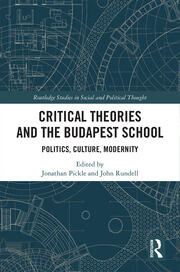
Critical Theories and the Budapest School Politics, Culture, Modernity
Introduction: The Budapest School and its legacies: migration, modernity, philosophy (Jonathan Pickle and John Rundell)
Part I: A School? Or its homecoming in migration
1. The Budapest School – Travelling Theory? (Peter Beilharz)
2. Learning from the Budapest School Women (Pauline Johnson)
3. Criticism and Aesthetics: Ferenc Fehér’s views on art (Sandor Radnoti)
Part II: From critique of totalitarianism to critique of political modernity
4. The Budapest School on Totalitarianism. Toward a new version of critical theory (Waldemar Bulira)
5. The Critical Power of Needs: The Radical Potential in Márkus’ and Heller’s Philosophical Anthropology (Aaron Jaffe)
6. Praxis Beyond the Political: György Márkus contra Hannah Arendt (Jonathan Pickle)
7. Pathways to the ‘Open Utopia’: Heller and Fehér on Lukács’ Messianic Marxism (Michael Gardiner)
8. Adventures in Biopolitics (John Grumley)
9. The Absolute Present of Historical Consciousness: Ágnes Heller between the Postmodern and the Contemporary (David Roberts)
Part III: Critical Theories of the Budapest School: Reflections on György Márkus and Ágnes Heller
10. Philosophy in the Times of Late Modernity: Reflections on György Márkus’ Culture, Science, Society (Janos Kis)
11. Ágnes Heller’s theory of action: the incompleteness of the human being (John Rundell)
12. Ágnes Heller and the Kantian Imaginary (Marcia Morgan)
13. Existential Choice as Existential Comedy: Ágnes Heller’s Wager (Katie Terezakis)
14. The Comic Political Condition: Ágnes Heller’s Philosophy of Laughter and Liberty (Peter Murphy)
15. The Image of the ‘Good Friend’ in Heller: A Bridge Between Everyday Life and Transcendence (Sergio Mariscal)
Index
Biography
Jonathan Pickle teaches in the Department of Philosophy and Religion at New Jersey City University, USA.
John Rundell is Principal Honorary and Associate Professor and Reader in Social Theory at The University of Melbourne, Australia.
