




1st Edition
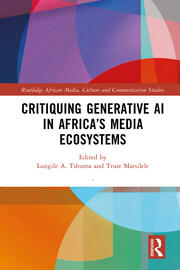
Critiquing Generative AI in Africa’s Media Ecosystems
Chapter 1: The Janus Face: The Critical View of Generative AI in Africa─ Lungile A. Tshuma and Trust Matsilele.
Section 1: Towards A Decolonial Approach to AI
Chapter 2: The Coming Coloniality: AI and Journalism─ Shepherd Mpofu and Phumla Q. Mhlanga.
Chapter 3: Sensible AI? An Apartheid Studies Treatise on Artificial General Intelligence─ Nyasha Mboti.
Chapter 4: Feminism and Algorithmic Bias in the Media: Is Gen AI a New Kind of Glass Ceiling for Women in the Global South? ─ Sibongile Mpofu.
Section 2: The Politics of Large Language Models
Chapter 5: Generative AI and Digital Disruption in African Newsrooms: From Theories to Practice─ Ayantola Alayande, Joshua Olufemi, Akintunde Babatunde,
Ibilolia Akahome
Chapter 6: Enhancing Digital Visibility of Low-Resource Language (LRL) Content in Kenya─ Njeri Ngaruiya, Esther Khakata, Fred Mucha, David Lemayian.
Chapter 7: Data Journalism in the Age of Generative Al: Complexity of Data Extraction from Limited African Language Repositories─ Limukani Mathe
Chapter 8: Media and Generative AI in Mozambique: The Limits of Digital Communication in A Disconnected Country─ Dércio Tsandzana.
Section 3: Ubuntu Centred Generative AI
Chapter 9: Generative AI and the Production of Ubuntu-Centric Journalism─Musawenkosi Ndlovu and Soligah Solomons.
Chapter 10: Generative Artificial Intelligence in Journalism and Its Perceived Cultural Implications in Rwanda─ Zimuto Nyasha Cefas.
Chapter 11: Generative AI: An Africa-Centric Examination of Emerging Media Ethics in Southern African Newsrooms ─Millie Phiri
Biography
Lungile A. Tshuma is researcher in the Centre for Communication and Culture, Universidade Católica Portuguesa. Tshuma is also Senior Research Associate in the department of Communication and Media, University of Johannesburg, South Africa.
Trust Matsilele is Senior Lecturer of Journalism at Birmingham City University, UK, and a Research Fellow in the Communication Department at the University of South Africa.
"At a time when many are uncritically celebrating the advent of AI, this book is a wake-up call on the oppressive and extractive side of AI technologies that build on ideological biases and extractive logics of coloniality. The book mobilises concrete examples, case studies and from alternative decolonial epistemes such as Ubuntu and Afrokology to argue for tech solutions and sovereignty that benefit Africa. It is an essential critique of the potentials and dangers characterising Artificial Intelligence, and generative AI’s insertion into African journalism, with disastrous consequences for education and African public life. While there is open acknowledgement of the benefits of AI to the journalism sector, what is remarkable is its loud worry about AI’s harms and dangers that are unfolding in ways that reinforce African marginalisation."
Winston Mano, Professor, Communication and Media Research Institute (CAMRI), University of Westminster.
"Critiquing Generative AI in Africa’s Media Ecosystems is a thought provoking and incisive decolonial interrogation of the growing influence of generative artificial intelligence on African media ecosystem, digital participation and knowledge production. Lungile Tshuma and Trust Matsilele and the contributors provide a compelling analysis of how AI technologies are reshaping African journalism, culture and society. In advocating for context-specific and Ubuntu-centred approaches to technological innovation that are rooted in Africa’s diverse epistemologies, the book challenges the asymmetries embedded in global digital infrastructures. The book is a timely intervention that reimagines AI as a tool for epistemic plurality and social empowerment in Africa and a must-read for anyone invested in digital justice, media transformation, and inclusive digital futures."
Sarah Chiumbu, Associate Professor, Department of Communication and Media, University of Johannesburg.
"Journalism practice has recently transformed substantially with the integration of artificial intelligence (AI) techniques in many parts of the world. Generative AI has emerged as a powerful tool within this context, encompassing the creation, production, and generation of content, insights, and data by computational systems. The increasing dependence on generative AI tools and the drive towards a connected and unified world has sparked debates on the ability of the news media in the Global South to effectively engage with new media technologies. And one cannot deny the fact that the use of generative AI in the countries of Global South comes with context-specific challenges and opportunities. When looking at the African media landscape, the region represents linguistic, cultural, and socio-political diversity, as well as heterogeneity in terms of journalists’ and news organizations’ resources and capabilities to utilize generative AI in routine practice. Hence, the book ‘Critiquing Generative AI in Africa’s Media Ecosystems’ is a timely and significant contribution that calls upon to think about generative AI not from a global perspective, rather it demands to think more local application of generative AI that align well with the regulatory, cultural, political and ethical frameworks of diverse news media ecosystems within Africa. It emphasizes co-creation emphasizing the active role of communities that are not mere data subjects or users, but partners and authors/co-authors in the shaping of digital futures. The underpinning local context approach of this book calls for contributions in other parts of the global South where news media ecosystems require context-specific knowledge and application of generative AI."
Sadia Jamil, Assistant Professor, School of International Communications, University of Nottingham, Ningbo, China.
