




1st Edition
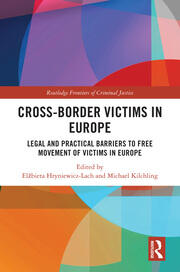
Cross-border Victims in Europe Legal and Practical Barriers to Free Movement of Victims in Europe
Part I Introduction
1. Who are the cross-border victims and why should we care for them
Elżbieta Hryniewicz-Lach and Michael Kilchling
2. Barriers to the free movement of victims in Europe
Elżbieta Hryniewicz-Lach
Part II. Spotlight on the real-life conditions for cross-border victims in selected jurisdictions
3. Cross-border victims in Austria
Karin Bruckmüller and Kristina Altrichter
4. Cross-border victims in Croatia
Lucija Sokanović
5. Cross-border victims in Germany
Michael Kilchling
6. Cross-border victims in Italy
Paola Maggio
7. Cross-border victims in the Netherlands
Suzan van der Aa
8. Cross-border victims in North Macedonia
Gordana Lažetić and Aleksandra Gruevska-Drakulevski
9. Cross-border victims in Poland
Elżbieta Hryniewicz-Lach
10. Cross-border victims in Spain
María José Rodríguez Puerta, Jorge González-Conejero and Emma Teodoro
11. Cross-border victims in Switzerland
Tiara Pramono, Linda Bergauer and Marianne Johanna Lehmkuhl
12. Cross-border victims in Türkiye
Tuğçe Duygu Köksal and Gökçe Bahar Öztürk Diler
Part III. Comparative perspectives
13. Victims’ rights in Europe – do cross-border victims fit within the current concepts and structures?
Suzan van der Aa and Antony Pemberton
14. The needs of cross-border victims and challenges thereto
Nina Peršak
15. Good practices in relation to cross-border victims
Lyane Sautner
16. Undocumented migrants: How to help those who (do not) want to be seen
Monika Szulecka
17. Free movement of victims in Europe: from diagnosis to possible intervention
Elżbieta Hryniewicz-Lach
Biography
Elżbieta Hryniewicz-Lach is associate professor of criminal law at the Law Faculty of Adam Mickiewicz University in Poznań, Poland. Her research interests focus on various aspects of the response to crime, the impact of a conviction on third parties, and the status of the victim in criminal law. She is the author of publications in Polish, English, and German, in the field of criminal law. She has participated in international research projects in criminal law and victimology.
Michael Kilchling is a senior researcher in the Department of Public Law at the Max Planck Institute for the Study of Crime, Security and Law, and a lecturer at the University of Freiburg. His main research interests include criminal law, penology, criminology, victimology, and restorative justice. He has contributed to a variety of international research projects and expert groups (national, European Union, Council of Europe, and United States).
This compilation offers us a brilliant and much needed collective work to understand the experiences of cross-border victims when confronting the gap between victim law in the text and victim law in action. Despite the celebration of the 40th anniversary of the 1985 UN Declaration of basic principles of justice for victims of crime and abuse of power and the 13th anniversary of the 2012 EU Directive on victims’ rights, we need to read carefully the pages of this collective book to understand why we are not respecting those rights. This unique book shows us concrete and practical guidance to, at least, not provoke further harm. Following those international standards, this book helps us to confront our legal and ethical duty to make real the globalisation of human rights beyond borders.
Gema Varona, President of the World Society of Victimology, Professor of Victimology at the Faculty of Law of Donostia/San Sebastián, Spain
This book is a must read for all victimologists. Even though it focuses on the problems of cross-border victimization, it clearly magnifies the issues faced by a much larger group of crime victims – and the ways we can address them. It is an example for international scholarship.
Marc Groenhuijsen, Professor emeritus at the Faculty of Law of Tilburg University, the Netherlands
Former president and holder of the Hans von Hentig Award of the World Society of Victimology
Cross-border victimisation is growing in its incidence and its effects, whether it be through cyber fraud attacks from abroad in one's home or when one travels abroad. Support and rights for such victims, however, have not kept up with this and there is a key need to renovate national and international systems and support to deal with such victimisation. This edited book will be a major resource to spur such change.
Joanna Shapland, Professor emeritus, University of Sheffield, UK
This excellent book addresses the special predicaments of those victimized by crime in Europe as non-residents. It provides both a thorough analysis of the issues as well as practical recommendations for action by national governments and European organizations.
Jan van Dijk, Professor emeritus in victimology and human security at Tilburg University, the Netherlands
Holder of the Hans von Hentig Award of the World Society of Victimology and winner of the Stockholm Prize in Criminology 2012
Levent Altan, Executive Director, Victim Support Europe, Brussels, Belgium
