




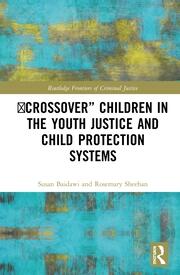

1st Edition
'Crossover' Children in the Youth Justice and Child Protection Systems
Introduction
Susan Baidawi
1 Child protection and youth offending: a cross-national concern
Susan Baidawi
2 Government and policy developments related to crossover children
Rosemary Sheehan
3 The characteristics and pathways of crossover children: the study explained
Susan Baidawi
4 Court records: the profile of "crossover kids"
Susan Baidawi
5 Crossover kids: professionals’ perspectives on offending and desistance
Rosemary Sheehan
6 Culture and Indigeneity: risk and responses for Indigenous crossover children
Rosemary Sheehan
7 The nature and contexts of offending among crossover children
Susan Baidawi
8 Crossover children: where criminogenic risk meets systemic disadvantage
Susan Baidawi
9 Disrupting the pipeline: decriminalising child protection-involved youth
Susan Baidawi
Biography
Susan Baidawi is Senior Research Fellow at the Department of Social Work, Monash University, Australia. Her research studies lie at the nexus of the child welfare and criminal justice fields, areas in which she holds significant research experience. She has conducted research and authored numerous studies, reviews, and evaluations in the fields of child protection, out-of-home care, and criminal justice. In 2019, Dr Baidawi was awarded a three-year Early Career Fellowship from the Australian Research Council to conduct ongoing research focusing on crossover children in collaboration with the Children’s Court in Victoria, Australia.
Rosemary Sheehan is Professor at the Department of Social Work, Monash University, Australia, and held, until recently, a Governor-in-Council post as Dispute Resolution Convenor in the Victorian Children's Court. Her published research investigates child welfare and the law, mental health, and judicial and corrections' responses to offenders, particularly women offenders. Her major study of children’s courts in Australia, co-authored with Allan Borowski, Australia’s Children’s Courts Today and Tomorrow, is widely claimed as a unique study examining the role, operation, and challenges in courts, and what models and legislation more effectively respond to the socio-legal problems children and young people present to the courts.
"This book provides stories and experiences of ‘crossover children’ and the systems that have not given them the care they need. Unfortunately these stories are far from rare. By providing an analysis that highlights systemic failures, the book is a call to action – we need to ‘disrupt the pipeline’ from child protection and out-of-home care to youth justice." — Julie Edwards, CEO of Jesuit Social Services, Australia
"This research provides an unflinching account of the criminalisation of childhood abuse and trauma, detailing the overlap of children in the youth justice and child protection systems. Attention to these children is long overdue; this research provides a vital and unprecedented picture of their experiences and their pathways into and beyond the youth justice system. It is research that absolutely must be used to inform the major improvements needed to ensure children get the support they deserve and need." — Liana Buchanan, Principal Commissioner for Children and Young People, Victoria, Australia
"Children who are in both the youth justice and care and protection systems usually have the most complex cases and worst prognosis of all who come before the court. Many pass through with little or nothing happening to change their trajectories toward adult offending. Paradoxically they are perhaps the least understood and worst catered for because we have not had the quality of information necessary to help inform effective ways to manage them.
In some courts, strategies such as crossover lists have been adopted to try and improve the way such cases are managed but, more often than not, these are ad hoc and based on anecdotal evidence only.
The type of thorough research, wide consultation and careful analysis needed to properly inform the necessary systemic change is contained in this excellent and thoughtfully compiled book. It captures the wide range of factors to be considered including the true scale of the issue and the diversity of perspectives held by the numerous professionals and agencies interested in the subject. For that reason, it should be compulsory reading for that entire audience including academics and policy makers.
It also goes beyond other research I have read by not only analysing data and looking at trends but also providing explanations for the trends and taking both a big picture and close-up look at the issues. Importantly too, it not only considers the various risk factors for these children but also reminds us that risk is not the same thing as destiny when the right opportunities are provided." — Judge Tony Fitzgerald, District and Youth Court Judge, New Zealand
