





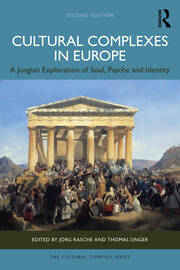
2nd Edition
Cultural Complexes in Europe A Jungian Exploration of Soul, Psyche and Identity
Part 1: Soul, Identity, and Cultural Complexes in Individual European Countries
1. Poland: The Suffering Hero and Messianism in a Polish Cultural Complex
Malgorzata Kalinowska
2. Greece: The Inner Riddle of “Greek Psychic Debt,”
Evangelos Tsempelis
3. Spain: The Catalan Vault
Olivia del Castillo
4. Czech Republic: The Forefather Cultural Complex
Martin Skála
5. Serbia: Belgrade: Limes and the City
Marijana Popović and Jelena Sladojević Matić
Part 2: The Feminine and Cultural Complexes in Europe
6. Denmark: Mother Denmark
Pia Skogemann
7. Italy: Queens, Saints, Heretics, Prostitutes
Caterina Vezzoli
8. Austria: Sisi
Maria Kendler
9. Italy: “Small Mother Complex” and the Royal Feminine
Marta Tibaldi
Part 3: The Greater European Family: Cultural Complexes in All European Countries
10. Europe: The Jewish Anima
Jörg Rasche
11. Israel: My European Animus
Erel Shalit
12. Israel: A Very Narrow Bridge: Israel and Its Cultural Complexes
Henry Abramovitch
13. Europe: The Ghosts of Two World Wars
Kristina Schellinski
14. Europe: Europe and Islam
Jörg Rasche
Biography
Jörg Rasche, MD, is a Jungian analyst in Berlin. He served for many years as president of the German Jungian Association (DGAP) and was vice-president of IAAP and president of the German Association for Sandplay Therapy (DGST). His books and articles include reflections on creativity, music, politics, and non-violent conflict resolution.
Thomas Singer, MD, is a psychiatrist and Jungian psychoanalyst who trained at Yale Medical School, Dartmouth Medical School, and the C. G. Jung Institute of San Francisco. He is the author of many books and articles that include The Cultural Complexes Series. He serves on the board of ARAS (Archive for Research into Archetypal Symbolism) and has served as co-editor of ARAS Connections for many years.
‘Qualities of passion and intellectual coherence co-exist in this extraordinary book, itself a product of history, politics, psychology and—often—personal experience and suffering. But what about the timing? Europe is in its deepest crisis since the Second World War and, in the absence of any credible solutions from conventional politics, depth psychology and the idea of cultural complexes are entitled to step into the breach. There is more: By assembling authors from so many different nations, Jörg Rasche and Tom Singer have created a special European union before our very eyes. They, and their stellar team of authors, have not only analysed the continental lines of conflict and war, but have also made noteworthy contributions to the achievement of peace-in-diversity.’
Professor Andrew Samuels, Author of A New Therapy for Politics?
‘This is a remarkable and original book and should be read by all those interested in Europe from historical, personal and cultural perspectives, including the roots of European conflicts and their implications for present-day issues. The authors are Jungian analysts or academics from different parts of Europe, and the book’s theoretical underpinning is the concept of cultural complexes, exploring their relevance, dynamics, positive and shadow aspects in individual countries. The editors, Jörg Rasche and Thomas Singer, and the publisher, Spring Journal Books, are to be congratulated for their vision in publishing at this time a book of high quality essays when contemporary Europe is in flux: struggling with its identity; with who belongs and who is excluded; with managing more flexible boundaries, especially challenging with the huge influx of refugees seeking sanctuary in European countries.
Jan Wiener, Director of Training, Society of Analytical Psychology, London; Former Co-Chair of the IAAP Education Committee with Responsibility for Eastern Europe
‘This book on Europe and its cultural complexes is both profound and perfectly timed. The individual articles are outstandingly written by authors who have a deep understanding of Jung and analytical psychology, and know how to connect that knowledge with the problems that Europe faces today. The viewpoints represented are essential to understanding the history of the different European countries and helpful in understanding why they are in such turmoil now. I highly recommend it.’
Thomas B. Kirsch, Former President of the International Association for Analytical Psychology
