



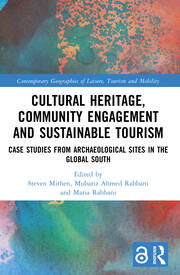

1st Edition
Cultural Heritage, Community Engagement and Sustainable Tourism Case Studies from Archaeological Sites in the Global South
1. Introduction
Steven Mithen, Mubariz Ahmed Rabbani and Maria Rabbani
Part 1. Asia
2. The Faynan Heritage Project: Developing a Local Museum within a Rural Bedouin Community of Southern Jordan
Steven Mithen, Bill Finlayson, Fatima Al-Nammari, Carol Palmer, Gehan Selim, Jessica Jacobs, Elaine Jamieson and Nebras Masalamani
3. Developing a Heritage-Themed Bedouin Handicraft Business in Faynan, Jordan: Success, Failure and Reflections
Steven Mithen, Obyda Hummash, Fatima Al-Nammari, Nebras Masalamani and Yursa al-Jabari
4. Community-Based Conservation and Promotion of the Neolithic Site of Beidha, Jordan
Bill Finlayson
5. Sela: Community and Heritage in Jordan
Maria Elena Ronza
6. The Land of Nineveh Archaeological Project: Cultural Heritage Protection and Enhancement, Community Engagement and Sustainable Tourism in the Kurdistan Region of Iraq
Daniele Morandi Bonacossi, Francesca Simi and Bekas Jamaluddin Hasan
7. Building Community Archaeology Practice and Heritage Tourism for Sustainable Development in a Post-Conflict Zone: The ACT and ALIPH Projects in the Swat Valley (Pakistan)
Luca M. Olivieri
8. Initiating the Transformation of Spanish Colonial Era Archaeology of Cagayan Province, Philippines, into Cultural Heritage
Caroline Marie Q. Lising and Grace Barretto-Tesoro
Part 2. Africa
9. Community and Archaeology at Armana: Exploring Sustainable Heritage Strategies for Rural Egypt
Kate Spence, Anna Stevens, Gemma Tully, Fathy Awad and Hamada Kellawy
10. Community-Engaged Archaeology at the UNESCO World Heritage Site of Jebel Barkal, Sudan
Rebecca Bradshaw, Tohamy Abulgasim, Suzanne Davis, Elmontaser Dafalla, Sami Elamin, El Hassan Ahmed Mohamed and Geoff Emberling
11. Co-Production Networks for Community Heritage in Tanzania (CONCH)
Paul Lane, Elinaza Mjema, Noel Lwoga and Stephanie Wynne-Jones
Part 3. Latin America
12. Santa Cruz Mixtepec: Community Engagement and Religious Heritage in Mexico
Alanna Cant
13. Biocultural Heritage and Archaeology as Sources of Knowledge, Cultural Identity, Sustainable Tourism and Economic Resilience in Ligüiqui, Manabí, Ecuador
Juan Andrés Jijón Porras, Manuel Castro Priego, Fernando Represa Pérez and Leonardo Alonzo Zambrano
14. The PIARA Peru Project at Hualcayán: An Archaeology and Partnership of Care
Rebecca Bria and Erick Casanova Vásquez
15. Utilising Cultural Heritage to Improve Water Security and Agro-Pastoral Farming in the Peruvian Andes
Kevin Lane, Nicholas Branch, Josephine Handley, Frank Meddens, Pedro Gonzalez, Douglas Walsh, Mario Advicula, Alexander Herrera, Cirilo Vivanco and Wilmer Moncada
Part 4. Overview
16. Experiences, Lessons, Celebration
Steven Mithen, Mubariz Ahmed Rabbani and Maria Rabbani
Biography
Steven Mithen, FBA, is Professor of Early Prehistory at the University of Reading, UK. His research interests include the origins of language, music and thought, hunter-gatherers and the emergence of farming. He has undertaken long-term field projects in southern Jordan and western Scotland and is a founding member of a local charity in Scotland (Islay Heritage, SCO46938). His books include The Prehistory of the Mind (1996), After the Ice: A Global Human History 20,000–5000 BC (2003), The Singing Neanderthals (2005), Thirst: Water and Power in the Ancient World (2007) and The Language Puzzle (2024).
Mubariz Ahmed Rabbani is working as a research engineer in archaeology at the French National Centre for Scientific Research (CNRS). His research interests include the study of the archaeology of South Asia and South-West Asia, focusing on ancient technologies, socio-economic and political organisation, trade, religion and human–environmental relationships. He completed his PhD in archaeology at the University of Reading and has worked on excavations in Pakistan, Iraq and the UK. He is Member of the ISMEO Italian Archaeological Mission in Pakistan.
Maria Rabbani is a Palynologist for Oxford Archaeology. She completed her PhD at the University of Reading, which focused on human-environmental interactions in the Zagros region during the Late Pleniglacial, Lateglacial and Holocene, using pollen, non-pollen palynomorph, micro- and macro-charcoal and geochemical analyses. Maria has experience in working on lake and wetland sediment and pollen from the UK, Italy, Iran and Iraq.
