




1st Edition
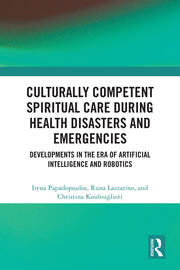
Culturally Competent Spiritual Care during Health Disasters and Emergencies Developments in the Era of Artificial Intelligence and Robotics
1.The need for cultural and compassionate competence in spiritual care
2. Philosophical, religious, and socio-anthropological perspectives of spirituality and spiritual care
3.Culturally competent spiritual care during major health disasters and emergencies
4.The provision of spiritual care during the COVID-19 pandemic in England: Challenges, barriers and good practices
5.The need for national strategies for the provision of culturally competent and compassionate spiritual care during major health disasters and emergencies
6.The experience of moral injury among healthcare professionals during the COVID-19 pandemic and its impact
7. Equality, diversity, and inclusion perspectives of culturally competent spiritual care during major health disasters and emergencies
8.Training health and care staff to deliver culturally competent and compassionate spiritual care
9.Digital technologies, robotics and other AI devices in the provision of culturally competent spiritual care
10.Global nurses’ reflections on spiritual care to patients, families and care staff, during the COVID-19 pandemic
11.Future Gazing
Biography
Irena Papadopoulos is Professor Emeritus at Middlesex University, London, where she established and headed the Research Centre for Transcultural Studies in Health in 1995. Dr Papadopoulos is the former Chair of the Research Team of the School of Nursing, Midwifery and Allied Health Professions and of the Ethics Committee. She co-founded ETNA (European Transcultural Nurses Association) and IENE (Intercultural Education for Nurses in Europe) programmes. She led the development of Papadopoulos, Tilki and Taylor (PTT) model for cultural competence (1998). During 2017–2021, she developed the guidelines for the creation of the first culturally competent socially assistive robot (The CARESSES project). She received numerous awards and authored a number of books and hundreds of articles.
Runa Lazzarino is a socio-cultural anthropologist working at the intersection of migration, health, and advanced technologies in healthcare. Currently, she is a Research Fellow at Middlesex University, London, and has held positions at UCL, Nottingham, and Oxford University. She co-leads projects on marginalized migrants and communities, cultural competence in healthcare and social care, with extensive research on human trafficking and digital health, innovatively integrating methods for policy impact.
Christina Koulouglioti holds a bachelor’s degree in nursing and a master’s degree in health care administration from the University of Athens, Greece. She completed her PhD and a post-doctoral fellowship at the School of Nursing, University of Rochester, USA. She currently holds a position as Senior Research Fellow at the Research and Innovation Department of University Hospitals Sussex NHS Foundation Trust. She has extensive research experience using different quantitative and qualitative methodologies and working with populations across the life span. She is an active member of Sigma Theta Tau International Honor Society of Nursing.
