





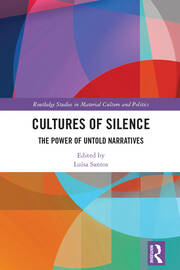
1st Edition
Cultures of Silence The Power of Untold Narratives
List of Figures
List of Contributors
Acknowledgements
Preface
Telling a Story of Silence(s) in Three Parts
Luísa Santos
Part I: (Embodied) Silence and Memory
1. Un-Silencing Bodies, Un-Silencing Lives: Artistic (Self-)Decoloniality and Artistic (Self-)Empowerment
Ana Fabíola Maurício
2. The Sound of Silence in the Age of Man
Diana Gonçalves
3. Ecocritical Perspectives on Nuclear Silence: Listening Across Multiple Scales
Hannah Klaubert
Part II: (Imposed) Silence and Identity
4. Burning Silence in the Country House: On Colonial Torchères at Betlér Manor
Rado Ištok
5. Queer Silences: Art, Sexuality and Acoustic Neuroma (The Art of Samak Kosem)
Vlad Strukov
6. Silence as a Weapon of Power Within the Context of the Portuguese Dictatorship
Irene Flunser Pimentel
7. [Inaudible]: The Politics of Silence in the Work of Lawrence Abu Hamdan and Gabrielle Goliath
Sven Christian
Part III: (Acts Of) Silence and Resistance
8. Undoing Language: Gender Dissent and The Disquiet of Silence
Athena Athanasiou
9. Rest as Resistance: From Self-Care to Decolonial Narratives
Sofia Ana Elise Steinvorth
10. Gender-Based Violence and COVID-19 Pandemic: Addressing a Pervasive Public Health Issue Through an Upstream Multi-Systems Approach
Nazilla Khanlou, Luz Maria Vazquez, and Soheila Pashang
Conclusion
11. On the Subject of Silence
Tânia Ganito
Index
Biography
Luísa Santos holds a PhD in Culture Studies from the Humboldt & Viadrina School of Governance, in Berlin, Germany and an MA in Curating Contemporary Art from the Royal College of Art, in London, UK. She is Assistant Researcher and Assistant Professor in Culture Studies/Artistic Studies at the CECC (Research Centre for Communication and Culture), Faculty of Human Sciences, Universidade Católica Portuguesa, Portugal, having been granted a Gulbenkian Professorship between 2016 and 2019. Having authored various publications in the domains of art and society, Luísa Santos sits on the editorial and scientific boards of the peer-reviewed magazines Estúdio, Gama, and Croma, and of the Yearbook of Moving Image Studies (YoMIS – Research Group Moving Image Kiel), Büchner-Verlag. Since 2018, she has been the co-artistic director of the nanogaleria, an independent curatorial project which she co-founded with Ana Fabíola Maurício.
"This book is an ambitious attempt to provide insights into and the necessary context for the field of research on cultural practices where silence can be utilized as both a tool of oppression and an instrument of resistance.
By combining different approaches, this book’s authors contribute to forming a new interdisciplinary research field where silence is seen as both a tool of oppression and an instrument of resistance. In this regard, the volume will be of interest not only to specialists in cultural, art, queer, or gender studies, but also to philosophers, historians, psychologists, and sociologists, who can find in the texts fresh ideas and new approaches to the study of the phenomenon of silence, which, despite its comprehensive nature, has not yet been adequately reflected in the research literature."
-- Aleksandr Veselov, in The February Journal, 01-02: 161-170. DOI: 10.35074/FJ.2023.94.98.009
