




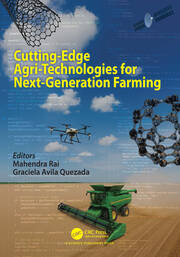
1st Edition
Cutting-Edge Agri-Technologies for Next-Generation Farming
Preface
Section I: General
1. Nanotechnology and AI in Next-Generation Agriculture
Graciela Avila Quezada and Mahendra Rai
Section II: Novel Nanotechnologies for Shaping Farming
2. Nanomaterials in Agriculture: Enhancing Soil Health and Plant Growth
Amanpreet K. Sidhu, Sanskruthi B. Agrawal, Naveen Verma and Priya Kaushal
3.Seed Nanopriming for Sustainable Crop Production
Joanna Trzcińska-Wencel, Julia Nadrowska, Aniket Gade, Sudhir S. Shende, Mahendra Rai and Patrycja Golińska
4. Emerging Nanopesticides: Opportunities and Challenges
Kamarshi Yashkamal and Muthugounder Subramaniam Shivakumar
5. Nanofertilizers for Sustainable Agriculture: Limitations and Future Trends
Arun Ghuge, Harris Panakkal, Rahul Bhagat, Mahendra Rai and Indarchand Gupta
6. Next-Generation Farming: Crop Monitoring with Nanosensor Technologies
Sergei Tarasov, Yulia Plekhanova and Anatoly Reshetilov
7. Nanobiotechnology for the Management of Plant Diseases
María de Jesús Briseño, Juan Jose Reyes-Pérez, Bernardo Murillo-Amador, Graciela Avila-Quezada, Roberto Gregorio Chiquito-Contreras and Luis Guillermo Hernández-Montiel
8. Nanotechnology for Plant Growth Promotion and Stress Tolerance
Sudhir S. Shende, Aniket Gade, Joanna Trzcińska-Wencel, Mahendra Rai and Patrycja Golińska
Section III: CRISPR-Cas9 Technology
9. CRISPR-Cas9 Editing Technology: Concept, Applications, and Prospects for Agriculture
Gleice Ribeiro Orasmo and Lidiane de Lima Feitoza
10. Genome Editing in Cereal Crops Using CRISPR-Cas9 Technology
Madhvi Sharma, Khaja Mohinuddin, Priya Shah and Amanpreet K. Sidhu
11. Genome Editing of Horticultural Crops Using CRISPR/Cas for Enhanced Improvement
Shivangi Rahangdale, Himanshu Pandey, Suhas Gorakh Karkute, Ram Krishna and Achuit Kumar Singh
12. Opportunities and Challenges of CRISPR/Cas Systems in Crop Breeding
Dipak Sarode, Madhavi Purankar, Rachayya Devarumath, Kapil Sushir, Prashant Kawar and C. Appunu
Section IV: Artificial Intelligence Technology
13. Introduction to the Application of Artificial Intelligence-based Solutions in Agriculture
Tavseef Mairaj Shah
14. Deep Learning for Crop Improvement
Caio Miguel Pantoja Mendonça, Vanessa Almeida da Rocha, Linda Grabiely Oliveira de Araújo, Josué Manoel Souza Serrão, Vitor Eduardo Lopes Monteiro, Daniel Neves Ferreira, Gustavo Guadagnucci Fontanari, Andrea Komesu, Mahendra Rai, Gledson Luiz Salgado de Castro and Luiza Helena da Silva Martins
15. Precision Farming and Decision Support Systems, Utilizing Convolutional Networks for Plant Detection
Yossef Rubalcava-Avila, Graciela Avila-Quezada, Cesar Berzoza-Gaytan and Mahendra Rai
16. Leveraging Artificial Intelligence for the Detection, Monitoring, and Forecasting of Plant Diseases
Prasad V. Sherekar, Divyesha A. Pathak and Sanvidhan G. Suke
17. Application of AI in Identification of Pests and Weeds
Amanpreet K. Sidhu, Tushar Patil, Siddhant Pawar, Savita Thakare and Ciara Marie Edwards
18. Ethical and Social Implications of AI in Agriculture
Isuri Devindi, Sashini Liyanage, Nadeesh Adassooriya and Roshan Ragel
Index
Editors’ Biography
Biography
Dr. Mahendra Rai is presently a Senior visiting Professor at the Department of Chemistry, Federal University of Piaui (UFPI), Teresina, Brazil. Formerly, he was Professor and Head of the Department of Biotechnology, SGB Amravati University, Maharashtra State, India. He was a visiting scientist at the University of Geneva, Debrecen University, Hungary; University of Campinas, Brazil; VSB Technical University of Ostrava, Czech Republic; National University of Rosario, Argentina, and the University of São Paulo. He has published more than 450 research papers in national and international journals, with 95 h-index. In addition, he has edited/authored more than seventy-five books owns 6 patents. He has been featured among the top 2% scientists in Nanoscience and Nanotechnology by Stanford University and is ranked 7th nationally in Biology and Biochemistry by Research.com.
Dr. Graciela Avila Quezada is a Professor at Faculty of Agrotechnology Science, Universidad Autónoma de Chihuahua, in México. She has been conducting research related to plant pathogens for thirty years, beginning with her undergraduate thesis work focused on the control of Puccinia graminis f. sp. avenae. She was a visiting scientist at the Volcani Center in Israel; Colegio de Postgraduados, Texcoco, Mexico; SENASICA Laboratories, Ministry of Agriculture in Tecamac, State of Mexico; the California Polytechnic State Univ-San Luis Obispo California (Calpoly); Institut de Recherche pour le Développement IRD Montpellier, France; Universidad Autonoma Chapingo, Mexico State; Universidad de Córdoba, Spain. Dr. Avila was President of the Mexican Society of Phytopathology; Vice-president of the National Phytosanitary Advisory Council (CONACOFI); Executive Secretary of the National System for Research and Technology Transfer (SNITT) of the Minister of Agriculture (Sagarpa); and Director of Academic Cooperation, in the Coordination of Science and Technology, Presidency of Mexico. Besides, she has conducted more than twelve research projects and published more than 70 research papers in national and international journals focused on plant pathogens. She is presently a visiting professor at the Universidad Complutense de Madrid, Spain.
