




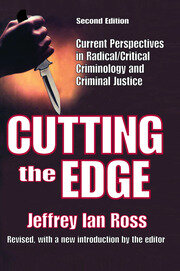
2nd Edition
Cutting the Edge Current Perspectives in Radical/Critical Criminology and Criminal Justice
Edited By Jeffrey Ian Ross
Copyright 2009
222 Pages
by
Routledge
222 Pages
by
Routledge
222 Pages
by
Routledge
Also available as eBook on:
Understanding crime, criminals, and criminal justice from a radical/critical perspective is indispensable in today's academic, applied research, and policy sectors. Neglect of this approach leads to narrow-mindedness and the probability of repeating past mistakes or reinventing the wheel. Cutting the Edge by Jeffrey Ian Ross will encourage individuals and organizations, especially students and... Read more
1: Introduction to the Second Edition: Cutting the Edge : What a Difference a Decade Makes? 1; 2: Cutting the Edge: Where have We been and Where are We Going?; 1: Perspectives in Criminology; 3: Insurgent Possibilities: The Politics of Cultural Criminology; 4: White Collar Crime and Critical Criminology: Convergence and Divergence; 5: Corporate Crime: A Panacea for Critical Criminology; 6: Toward a Supranational Criminology; 2: Perspectives in Criminal Justice; 7: Radical and Critical Criminology’s Treatment of Municipal Policing; 8: A House Divided: Corrections in Conflict; 9: A Convict Criminology Perspective on Community Punishment: Further Lessons from the Darkness of Prison; 10: The Potential for Fundamental Change in Juvenile Justice: Implementing an Alternative Approach to Problem Youth; 11: Razing the Wall: A Feminist Critique of Sentencing Theory, Research and Policy; 12: A Geometry of Its Own: Restorative Justice, Relationships and Community in Democracy
Biography
Jeffrey Ian Ross
Even for those who appreciated the first edition of the book, this new effort is worth looking at because it captures critical criminology's emerging focus on not just witnessing the effects of race, crime, and gender on justice, but also advocates a progressive agenda for change...The articles are uniformly well-written, interesting, and challenging...Cutting the Edge: Current Perspectives in Radical/Critical Criminology and Criminal Justice make a substantial contribution toward the development of a criminology that has the potential to change individual lives and social institutions.- -John Randolph Fuller, Critical Sociology "Even for those who appreciated the first edition of the book, this new effort is worth looking at because it captures critical criminology's emerging focus on not just witnessing the effects of race, crime, and gender on justice, but also advocates a progressive agenda for change...The articles are uniformly well-written, interesting, and challenging...Cutting the Edge: Current Perspectives in Radical/Critical Criminology and Criminal Justice make a substantial contribution toward the development of a criminology that has the potential to change individual lives and social institutions." -John Randolph Fuller, Critical Sociology "Even for those who appreciated the first edition of the book, this new effort is worth looking at because it captures critical criminology's emerging focus on not just witnessing the effects of race, crime, and gender on justice, but also advocates a progressive agenda for change...The articles are uniformly well-written, interesting, and challenging...Cutting the Edge: Current Perspectives in Radical/Critical Criminology and Criminal Justice make a substantial contribution toward the development of a criminology that has the potential to change individual lives and social institutions." -John Randolph Fuller, Critical Sociology "Even for those who appreciated the first edition of the book, this new effort is worth looking at because it captures critical criminology's emerging focus on not just witnessing the effects of race, crime, and gender on justice, but also advocates a progressive agenda for change...The articles are uniformly well-written, interesting, and challenging...Cutting the Edge: Current Perspectives in Radical/Critical Criminology and Criminal Justice make a substantial contribution toward the development of a criminology that has the potential to change individual lives and social institutions."-John Randolph Fuller, Critical Sociology
