




1st Edition
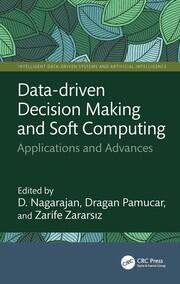
Data-driven Decision Making and Soft Computing Applications and Advances
1. Introduction to Data-Driven Decision Making. 2. Application of Graph Energy in Glaucoma detection using Machine Learning Techniques. 3. A comprehensive review on Applications of fuzzy planar graphs. 4. Optimizing Sustainable Supply Chain Inventory Model: A Fuzzy-Based Integrated Approach with Two-Warehouse and Dual-Mode Inspection. 5. Enhancing Advanced Additive Manufacturing for Uncertain and Complex Domains. 6. Blockchain-Powered Food Waste Management in Enhancing Traceability and Sustainability. 7. An inventory stock with a cash flow model under Cloud Fuzzy and its applications. 8. Manpower Planning Optimization using Fuzzy Genetic Algorithms. 9. Dynamic Neutrosophic Decision Matrix (DNDM) for Smart City. 10. Plithogenic Way of Decision Making in Traffic Signal Time Setting. 11. Enhanced Air Traffic Prediction Using XGBoost: A Data-Driven Approach for Optimized Airport Operations. 12. Multi attribute Decision Making in Hesitant Fuzzy Environments. 13. Fuzzy Optimization Framework for Inventory and Maintenance Management in Sustainable Production Processes. 14. Demand Forecasting for Adidas Using Long Short-Term Memory (LSTM) Networks: A Fuzzy Logic Approach. 15. Ethical and Privacy Considerations in Data-Driven Decision-Making. 16. A Sustainable Joint Replenishment model with replacement options of imperfect items with inspection errors under pentagonal fuzzy numbers
Biography
Nagarajan Deivanayagampillai received the PhD degree from Manonmaniam Sundaranar university. He is a highly accomplished professor in the Department of Mathematics at Rajalakshmi Institute of Technology and a Postdoctoral Researcher at the Faculty of Engineering and Technology, Multimedia University, Jalan Ayer Keroh Lama, 75450 Melaka, Malaysia. With 25 years of extensive teaching and research experience both nationally and internationally, he has made remarkable contributions to his field. He has published over 150 high-impact journal articles, secured four patent grants, and obtained one international copyright. He has successfully completed two international research projects and holds key editorial positions, serving as an Associate Editor for Franklin Open and an Academic Editor for the Journal of Mathematics, Advanced Fuzzy Systems, Computational and Mathematical Methods, and the International Journal of Biomedical Imaging. Additionally, he is a visiting professor for the Global Learning Programme (GLP) at ITS, Surabaya, Indonesia, and an esteemed editorial board member for several prestigious journals.
Dragan Pamucar received the M.Sc. degree from the Faculty of Transport and Traffic Engineering, Belgrade, Serbia, in 2009, and the PhD degree in applied mathematics, with a specialization in multi-criteria modeling and soft computing techniques from the University of Defence, Belgrade, in 2013. He is currently an Associate Professor with the Faculty of Organizational Sciences, University of Belgrade. He has five books and more than 220 research articles published in SCI-indexed international journals, including Expert Systems with Applications, Applied Soft Computing, Soft Computing, Computational Intelligence, Computers and Industrial Engineering, Engineering Applications of Artificial Intelligence, IEEE Transactions on Intelligent Transportation Systems, IEEE Transactions of Fuzzy Systems, IEEE Transactions on Transportation Electrification, Information Sciences, and Information Research. According to Scopus and Stanford University, he is among the World’s Top 2% of scientists as of 2020. According to WoS and Clarivate, he is among the Top 1% of highly cited researchers. His research interests include computational intelligence, multi-criteria decision-making problems, neurofuzzy systems, fuzzy, rough and intuitionistic fuzzy set theory, and neutrosophic theory, and their application areas include a wide range of logistics and engineering problems.
Zarife Zararsız received the M.Sc. and PhD degrees from Nevşehir Hacı Bektaş Veli University, Nevşehir, Turkey. She is an Associate Professor with Nevşehir Hacı Bektaş Veli University, Nevşehir, Turkey. Her research interests include sequence spaces, especially almost convergent sequence spaces and application of the fuzzy sets in medicine and other areas of the science.
