




1st Edition
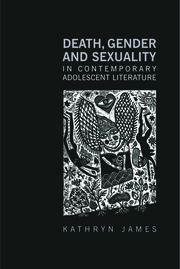
Death, Gender and Sexuality in Contemporary Adolescent Literature
Series Editor’s Foreword
Acknowledgments
Introduction: Beginning with Endings: Death in Children’s Literature
Chapter One: Points of Departure: Death, Culture, Representation
Chapter Two: Matilda’s Last Dance: Death and Historical Fiction
Chapter Three: Verisimilitude: Representing Death "In the Real"
Chapter Four: Beyond Consensus Reality: Death and Fantasy Fiction
Chapter Five: Imagined Futures: Death and the Post-Disaster Novel
Conclusion: Mapping the Landscape: The Unknown Country
Notes
Bibliography
Index
Biography
Kathryn James teaches children's literature at Deakin University, Melbourne. Her publications have appeared in Papers: Explorations into Children’s Literature, Children’s Literature in Education, and New Talents 21C.
"Death is universal and inevitable, which is precisely why James (Deakin Univ, Melbourne, Australia) believes its frequent appearance in adolescent literature, to date little studied, is a topic worthy of analysis...James makes a good case for the application of her ideas to other Anglophone literature, and without doubt she breaks new ground in the study of a topic widely represented in fiction for teens, yet not widely studied...Recommended."
-- Choice, June 2009
'Uncompromising in its refusal to sentimentalise either adolescent experience or its representation, Death, Gender and Sexuality in Contemporary Adolescent Literature forces its readers to confront what is at stake in the ideologies underlying fiction for young adults.' - Shelley King, Times Higher Education Supplement
