



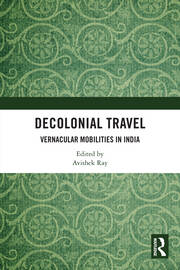

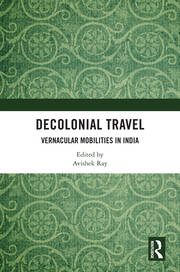
Introduction
1. Decolonizing Travel(ing Theory), or the Discursive Limits of the ‘(Post)Colonial’/ Avishek Ray
The Pre-Colonial and the Scriptural
2. To go is to know (that you never went): A Sanskrit Buddhist map of selected illusions/ Mattia Salvini Dharmavardhana Jñānagarbha
3. Vedic Travel: The Agnihotra and Beyond/ Lauren M. Bausch
The State, Polity and the Religious
4. Travel(-ing) to Write: Authorship and Agency in an Era of Inter-Polity Mobility/ Rafia Khan
5. The power of itinerancy: Religious leaders in the Nepal-India borderland/ Martin Gaenszle
Language and the Literary
6. “Floating straight obedient to the stream”: Bibliomigrancy and riverine journeys in colonial Bengal/ Swati Chattopadhyay
7. Moving in Circles: ‘Chakkars’ in Rajasthani Women’s Songs/ Nilanjana Mukherjee & Gaurav Kumar
The Trope of Homelessness
8. Homeless in Gujarat and India: On the curious love of lndulal Yagnik/ Ajay Skaria
9. The Homeless Gandhi/ Vinay Lal
Biography
Avishek Ray teaches at the National Institute of Technology Silchar. He is the author of The Vagabond in the South Asian Imagination: Representation, Agency & Resilience (2021) and co-editor of Nation, Nationalism and the Public Sphere: Religious Politics in India (2020). His research interests span space and mobility, (post)nationalism and postcolonialism. In 2021, he was awarded a Fulbright-Nehru Academic and Professional Excellence Fellowship.
"This is an intriguing and challenging book. Its contributors, characters, and constituents seize upon and severally straddle the terms, textures, and tangles of long-ranging pasts and diverse practices in South Asia. Taken together, the explorations on offer of “vernacular mobilities” do more than what meets the eye. They underscore instead the urgent requirements today of rethinking and unthinking not only “coloniality” and “postcoloniality” but equally “decoloniality” and “travel.” And to do so by tracking the enticements and incitements of these formidable fabulations – as metaphor, optic, and provocation."
Saurabh Dube, Distinguished Professor, El Colegio de México, Mexico City & Distinguished Research Fellow, Max Weber Forum for South Asian Studies, Germany-India
"Departing wisely from the long-cherished prism of "precolonial-religious and postcolonial-secular," this important book builds upon recent work in the field of colonial and vernacular modernities project in South Asia. Drawing from the rich literary landscape of the Indian subcontinent, the contributors explore variously ‘alternative travel performances,’ in spatial and temporal terms, embracing a vast and rich cornucopia of travel narratives. This is a pioneering volume: original, insightful, and provocative. A valuable contribution to Indian Travel Writings and South Asia Studies."Sachidananda Mohanty, Editor of Travel Writings and the Empire, Former Professor of English, University of Hyderabad & Former Vice-Chancellor, Central University of Odisha
