




1st Edition
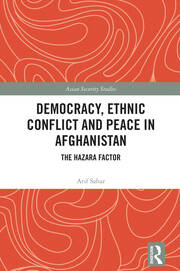
Democracy, Ethnic Conflict and Peace in Afghanistan The Hazara Factor
Introduction Chapter 1: The Ethnic Conflict in Afghanistan: A Political Economy Analysis Chapter 2: Ethnic Polarizations: The Case of the 2004 and 2009 Presidential Elections Chapter 3: Ethnic Confrontations: The 2014 Presidential Election Experience Chapter 4: Ethnic Crisis: The 2014 Presidential Election Chapter 5: Advancing Peace: The Hazara People’s Struggles I: Education for Liberation and Rights Chapter 6: Advancing Peace: The Hazara People’s Struggles II: Civil and Political Activism for Democracy Conclusions
Biography
Arif Sahar is a research fellow in the Department of Politics and International Studies at the University of Warwick, UK. He holds a PhD from University College London on the political economy of education and international development in Afghanistan. He is the co-author of Reconceptualizing Securitization in Afghanistan: Ethnicity, Social Identity, and Higher Education Post-2001 (Routledge, 2024).
‘Democracy, Ethnic Conflict and Peace in Afghanistan offers a vital exploration of Afghanistan’s complex journey through conflict, democracy, and peace, with a keen focus on the experiences and contributions of the Hazara people. Arif Sahar demonstrates an impressive command of both historical context and contemporary realities, providing insightful analysis of the pivotal years following the 2001 US-led intervention. The book stands out for its balanced perspective, thorough research, and compassionate portrayal of its subjects. By interweaving scholarly rigour with genuine empathy, Sahar not only deepens our understanding of Afghanistan’s challenges but also highlights pathways toward reconciliation and democratic development.'
Christian Kaunert, Professor of International Security, Dublin City University, Ireland & Professor of Policing and Security & Director of the International Centre for Policing and Security, University of South Wales, UK
'An uncommon combination of scholarly depth and narrative force has been achieved in this book. Big questions are confronted directly—power, exclusion, state-making, and violence—while the analysis remains grounded in close, patient attention to how politics is experienced from below. It should be read not only by specialists, but by anyone seeking a serious, unsentimental account of why “inclusion” so often fails in practice. This is an outstanding book by an author who will be regarded as a leading international voice in the field.'
Oz Hassan, Reader of National Security in the Politics and International Studies Department at the University of Warwick, UK
‘Democracy, Ethnic Conflict, and Peace in Afghanistan is a theoretically powerful, empirically rich, and analytically bold account of the ethnopolitical violence that has been shaping the country’s contemporary history. Sahar provides a critical and sophisticated analysis of the conflict as an ethnic civil conflict, which has often been denied by the dominant discourse regime. Sahar’s elegantly written book helps us understand the conflict in Afghanistan more vividly and accurately and his proposal of the resolutions of the conflict guides us to new insights that are crucial to the overcoming of the conflict. Based on in-depth fieldwork and several years of critical engagement with Afghanistan, Sahar deploys a critical interdisciplinary framework and opens a new frontier in Afghanistan studies.'
Sarah Leonard, Professor of International Security, University of South Wales and Jean Monnet Chair at Dublin City University (DCU), Ireland
