




1st Edition
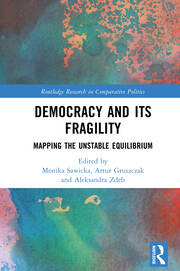
Democracy and Its Fragility Mapping the Unstable Equilibrium
Introduction: The ‘super-election’ year and the timeliness of democratic fragility
ALEKSANDRA ZDEB, ARTUR GRUSZCZAK AND MONIKA SAWICKA
1 Democracy: The contemporary understandings
ARTUR GRUSZCZAK
2 Democracy: A fragile notion
ALEKSANDRA ZDEB AND MONIKA SAWICKA
3 A fools errand? Quantifying democratic fragility
MONIKA SAWICKA AND MARK MCQUAY
4 Declining press freedom as a source of democratic fragility in Japan
MARK S. COGAN
5 Causes and sources of South Korea’s fragile democracy
HANNES B. MOSLER
6 Screening Indian democratic fragility: The question of press freedom
ALEKSANDRA JASKOLSKA
7 Fragility of post-conflict consociational democracies:
Bosnia and Herzegovina and North Macedonia in the quest for democratic stability
ALEKSANDRA ZDEB
8 Black chronicle: Criminal state capture and democratic fragility in Montenegro
MARK MCQUAY
9 Endemic fragility? The case of consociational power-sharing in Lebanon
DREW MIKHAEL
10 Pressure from new churches and the fragility of Kenyan democracy
JEDRZEJ CZEREP
11 Dwindling democratic dividends and democratic fragility in Nigeria
JIMOH AMZAT
12 Societal cracks expressed through la grieta. Political polarization and democratic fragility in Argentina
MAGDALENA LISIŃSKA
13 Fake news and fragility: Bolsonaro and the Supreme Federal Court in the pendulum of Brazilian democracy
AMURABI OLIVEIRA
14 Criminal governance and democratic fragility in Mexico
LORENA TORRES SALMERON, SABINA MORALES ROSAS, CARLOS A. PEREZ RICART
15 Polarization, partisanship and democratic fragility in the United States of America
MACIEJ TUREK
Conclusions: the modalities of democratic fragility
ARTUR GRUSZCZAK, MONIKA SAWICKA AND ALEKSANDRA ZDEB
Index
Biography
Monika Sawicka is Assistant Professor at the Institute of American Studies and Polish Diaspora, Jagiellonian University. Her research interests include Brazilian foreign policy, contemporary Brazilian politics, role theory and democratic fragility in Latin America. Her recent publications include the monograph Brazil’s International Activism. Roles of an Emerging Middle Power (Routledge 2023) and paper “The Curious Case of Vandals: Brazil’s Environmental and Regional Policies in the Bolsonaro Years” in Third World Quarterly (2024).
Artur Gruszczak is Professor of Social Sciences and Chair in National Security at Jagiellonian University in Krakow, Poland. His research areas include postmodern warfare, democratic governance, migration and internal security in the EU. His recent publications include the Routledge Handbook of the Future of Warfare (co-edited with Sebastian Kaempf, Routledge 2024), Technology, Ethics and the Protocols of Modern War (co-edited with Paweł Frankowski, Routledge 2018) and Cross-Disciplinary Perspectives on Regional and Global Security (co-edited with Paweł Frankowski, Palgrave Macmillan 2018).
Aleksandra Zdeb is Assistant Professor at the University of the National Education Commission in Krakow and Visiting Researcher at the Queen’s University Belfast. She holds a PhD in law and politics from the University of Graz and was a post-doc at the Queen’s University Belfast where she worked on topics of excluded groups and good governance in post-conflict societies. She is author of An Ordinary Demonstration of Power. On the Management of the Conflict in Bosnia and Herzegovina (in Polish, Universitas 2022) and papers on post-conflict reconstruction and state-building processes in journals including Ethnopolitics, Nationalities Papers, Representation, Social Inclusion, Swiss Political Science Review.
