





1st Edition
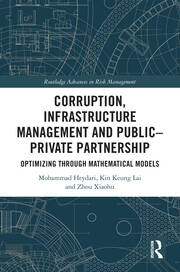
Corruption, Infrastructure Management and Public–Private Partnership Optimizing through Mathematical Models
1. Risk Management, Corruption, and Game Theory in Public–Private Partnership. 2. Corruption and its Impact on Government Policies and Evaluating Public–Private Partnership. 3. Game Theory Approach to Corruption in Public–Private Partnership. 4. Decision-Making Criteria for Selecting and Evaluating Public–Private Partnership: Case Studies. 5. Investment Decision and Corruption. 6. Public–Private Partnership for Infrastructure and Combating Corruption. References.
Biography
Mohammad Heydari is an Iranian writer and researcher. Currently, he is a candidate for the ‘National Young Talent Program,’ and he works as the youngest associate professor at Southwest University in Chongqing, China.
Kin Keung Lai is currently a Professor at International Business School, Shaanxi Normal University, Xi'an, China.
Zhou Xiaohu is currently a professor at the School of Economics and Management, Nanjing University of Science and Technology.
