





1st Edition
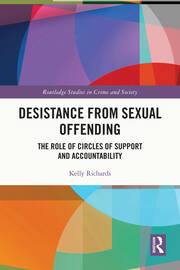
Desistance from Sexual Offending The Role of Circles of Support and Accountability
Introduction
Prevalence and Criminal Justice Response to Child Sexual Abuse
Stigmatisation of People Convicted of Sexual Offences
The Emergence of Circles of Support and Accountability
Outline of the Book
Chapter 1. Situating Circles of Support and Accountability
How Do CoSA Work?
Who Volunteers in CoSA?
Do CoSA Work?
Chapter 2. Theorising Circles of Support and Accountability
Existing Theorisations of CoSA
The Risk, Needs, Responsivity model, the Good Lives Model, and CoSA
Understanding Desistance
CoSA as Desistance-Promotion
Conclusion
Chapter 3. Researching Circles of Support and Accountability
Methodological Approach
Participant Sampling and Recruitment
Data Collection
The Participants
Making Sense of the Data
Ethical Considerations
What Was It Like?
Conclusion
Chapter 4. A Shot at Redemption: Circles of Support and Accountability, Desistance and Redemption Scripts
Redemption and Condemnation Scripts
Desistance and People Who Have Sexually Offended
Alan’s Story
Establishing a True, Good Self
Identifying a "Bad It"
Incorporating a Sense of "Tragic Optimism"
Developing a Sense of Optimistic Control and Self-Efficacy
Conclusion
Chapter 5. Circles of Support and Accountability, the 110-Percenters and Witnesses to Identity Transformation
Todd’s Story
The 110-Percenters
If Desistance Uccurs in the Woods and There Is No One There to See it…
Adam’s Story
Conclusion
Chapter 6. Giving Back from a Hopeless Place: Circles of Support and Accountability and Generativity
Rory’s Story
What is Generativity?
Core Members and the Will-to-Generativity
Paying it Forward: From Projectivity to Generativity
Zack’s Story
Helping Out a Brother: Core Members and Reintegration Advocacy
Generativity and Managing the Risky Self
CoSA Volunteers as the Subjects of Generativity
Conclusion
Chapter 7. Circles of Support and Accountability and Core Members as Wounded Healers
Wounded Healers in the Criminal Justice Context
Wounded Healers and CoSA
Morgan’s Story
‘Cheeseburgers Are on Wednesday’: CoSA and Wounded Healers’ Unique Expertise
CoSA, Wounded Healers and Identity Transformation
Daniel’s Story
Conclusion
Chapter 8. Implications for Practice: Delivering Circles of Support and Accountability as Desistance-Promotion
The Key Arguments
Assisting Desistance in Practice
Conclusion
Conclusion
Limitations of the Study
Future Research Directions
Victim/Survivor and Public Views of CoSA
Conclusion
Biography
Kelly Richards holds a PhD in criminology from Western Sydney University. She is currently an Associate Professor in the School of Justice at Queensland University of Technology, where her research focuses primarily on those who perpetrate sexual violence. In 2010, she was awarded the ACT Government Office for Women Audrey Fagan Churchill Fellowship to investigate Circles of Support and Accountability in Canada, America and the United Kingdom. She was recently awarded a Fulbright Senior Scholar Award and will use this to further her research at California State University and the University of Vermont. She lives in Brisbane with her husband and Staghound X, and enjoys hiking, music and pub trivia.
