




1st Edition
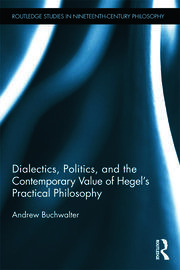
Dialectics, Politics, and the Contemporary Value of Hegel's Practical Philosophy
1. Introduction: Dialectics, Politics, and the Contemporary Value of Hegel’s Practical Philosophy Part 1: Normative Political Theory in Dialogue 2. Hegel, Marx, and the Concept of Immanent Critique 3. Hegel, Adorno, and the Concept of Transcendent Critique 4. Law, Culture, and Constitutionalism: Remarks on Hegel and Habermas 5. Political Pluralism in Hegel and Rawls Part 2: Modernity and Secularity 6. Hegel and the Doctrine of Expressivism 7. Hegel, Hobbes and Kant on the Scienticization of Practical Philosophy 8. Hegel’s Concept of Virtue 9. Political Theology and Modern Republicanism: Hegel’s Conception of the State as an "Earthly Divinity" Part 3: Eurocentrism, Globality, and Interculturalism 10. Hegel’s Conception of an "International ‘We’" 11. Hegel, Global Justice, and the Logic of Recognition 12. Is Hegel’s Philosophy of History Eurocentric?
Biography
Andrew Buchwalter is John A. Delaney Presidential Professor at the University of North Florida. He was Fulbright Professor at the University of Bochum Germany. He is Vice-President of the Hegel Society of America.
"To be sure, establishing contemporary value is hardly the only reason to study the history of philosophy, and one might think that such an emphasis can obscure much of what is interesting and valuable in learning from the past. So we can take Andrew Buchwalter's attempt to show how Hegel's practical philosophy has contemporary value to be a project of distinctive ambition. It is a project that he pursues carefully, developing arguments informed by extensive knowledge of the relevant debates and sensitive to troubling issues of our period." – Richard T. Peterson, Michigan State University, Notre Dame Philosophical Reviews
"The work’s encyclopaedic structure is advantageous for Hegelian scholars focusing on a specific philosophical or political issue, as well as to a wider audience. The chapters are concise and clearly articulated and most arguments are backed by a comprehensive account of the original sources (Kant, Hegel, Hobbes, as well as Marx, Adorno, Rawls and Habermas, among others), ‘classic’ commentators, more recent critical contributions and even recently discovered lecture versions of Hegel’s political philosophy, which may point to new and exciting research directions." – Bernardo Enes Dias, New University of Lisbon, Hegel Bulletin
