




1st Edition
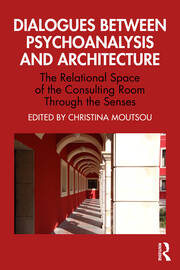
Dialogues between Psychoanalysis and Architecture The Relational Space of the Consulting Room Through the Senses
Introduction
Christina Moutsou
Part One: The Relational Space of the Consulting Room Through the Senses
1. In the Beginning is Smell: The Sense of Belonging and Remembering and the Impact of its Loss in Psychotherapy
Christina Moutsou
2. Hearing Other Voices: The Ear as the Eye of Invisible Class Discrimination
Anastasios Gaitanidis
3. Touching Nostalgia and Regret When Lying to Tell the Truth on the Couch
Christina Moutsou and Salma Siddique
4. The Therapy Consulting Room in a Medical Setting as Experienced Through the Senses
Vanessa Pilkington
5. Unfurling Ariadne's Thread: Psychic Connections and the Engagement of the 'Sixth Sense' in the Consulting Room
Christina Moutsou
Part Two: Dialogues Between Architecture and Psychoanalysis
6. On the Architect's Couch: Elective Affinities Between Architecture and Psychoanalysis
Korina Filoxenidou and Katerina Kotzia
7. Dialogues Between Architecture and Psychotherapy: Revisiting Four Consulting Rooms
Korina Filoxenidou and Natalia Varfi
Part Three: The Online Consulting Room During the COVID-19 Pandemic and Beyond
8. The Screen Therapy Room: Real Flowers in a Digital Vase
Dora Tsogia
9. Sensual Deprivation and Therapy During the Covid-19 Pandemic
Christina Papachristou
10. Observing and Consulting in Digital Aquariums
Salma Siddique
Biography
Christina Moutsou, Ph.D., is a psychoanalytic therapist, social anthropologist and author. She has worked as a lecturer and supervisor in various academic institutions and organisations, and in private practice in London for more than 20 years. Her publications include Fictional Clinical Narratives in Relational Psychoanalysis (2018), and her debut novel, Layers (2018).
'I cannot recall the last time that I encountered such a truly original book. Drawing upon her training in both mental health and, also, anthropology, Dr. Christina Moutsou has curated a deeply compelling collection of essays by talented writers, who transport us on an engaging tour of the consulting room through the senses. I only wish that I had absorbed all of this wisdom decades ago when I rented my very first consulting room! This volume should be required reading for psychoanalytical trainees and practitioners of ever age and shape and size.' Brett Kahr, professor; senior fellow at the Tavistock Institute of Medical Psychology, London; visiting professor of psychoanalysis and mental health at Regent's University, London; and honorary director of research, Freud Museum, London
'How does the physical and sensory space of the consulting room impact on the psychic space that develops within psychoanalysis? And in the wake of the COVID-19 pandemic, how does the use of the virtual therapy room change or facilitate analytic work? Christina Moutsou is to be congratulated on providing us with a wonderfully original and stimulating book that addresses these and other timely questions. With the help of distinguished contributors from the fields of both psychoanalysis and architecture, she has created a fascinating dialogue between disciplines that are too rarely considered together.' Rosemary Rizq, Ph.D., CPsychol, AFBPs, FHEA, Professor Emerita of Psychoanalytic Psychotherapy, University of Roehampton, London, UK
'This book comes as an extraordinary gift to let us reconsider the complex relationships between imagining and creating spaces, the senses, and the process of crafting a psychoanalytic mind. Even in the face of pain and loss, emerging from the bound and the ordered allows us to claim unanticipated freedom in the fragility and vitality of the senses to retrieve the spontaneity of wonder, shift the drivenness of the mind, and achieve growth.' Emmanouil Manakas, Ph.D., psychoanalytic psychotherapist, North Hellenic Psychoanalytic Society
