




1st Edition
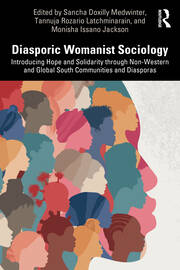
Diasporic Womanist Sociology Introducing Hope and Solidarity through Non-Western and Global South Communities and Diasporas
Introduction to Diasporic Womanist Sociology
SANCHA DOXILLY MEDWINTER, TANNUJA ROZARIO LATCHMINARAIN, AND MONISHA ISSANO JACKSON
Part I: Diasporic Womanism: Decolonial Theory, Method, Pedagogy, and Vocational Praxis
1 Diasporic Womanism: A Decolonial Project of Global South Diasporas and Allies
SANCHA DOXILLY MEDWINTER
2 A Diasporic Womanist Critique of Higher Education and Sociology
MONISHA ISSANO JACKSON
3 Towards a Womanist Methodology
TANNUJA ROZARIO LATCHMINARAIN
Part II: Black Womanist Knowledges: Midwifery, Religion, and Spirituality
4 A Labor of Love: A Womanist Exploration of the Historical and Contemporary Formations of Black Birthing Hush Harbors
ROSE E. ARCHER
5 A Case for Sonic Womanism: Spiritual Activism in Black Women’s Sound
IRIS REDDICK MANBURG
6 When Black Protestant Women Enter: Introducing Womanist Theological Methods to Sociology of Religion
STEPHANIE M. HOUSE-NIAMKE
Part III: Community Survival: Racial Violence, Genocide, and Caste
7 Our Multiple Deaths
JULIANA GÓES
8 From the Trenches of Dalit Insurgencies
SWATI BIRLA
9 Yes, the Subaltern Speaks: US Imperialism, Genocidal “South” Korea, and In/visible Womanism in Jeju
VEDA HYUNJIN KIM
Part IV: Diasporic Womanist Migrations: Reflexivity and Positionality
10 Becoming through Collaboration: A Caribbean Womanist Ethnography with Indigenous Women in Guyana
HOLLIS FRANCE
11 Stitching in Knots: Art-Making as Knowledge-Making in the Chinese-West Indian Diaspora(s)
GRAYSON CHONG
12 Knowing Your Place: Home Is More than a Passport for Diaspora Women
MELISSA JACKSON-WAGNER
Biography
Sancha Doxilly Medwinter, PhD, is a Diasporic Womanist Sociologist and Community-based Researcher. Her most recent book is Ecologies of Inequity: How Disaster Response Reconstitutes Race and Class Inequality. She is also a Co-author of Caribbean Womanism: Decolonial Theorizing of Caribbean
Women’s Oppression, Survival, and Resistance.
Tannuja Rozario Latchminarain, PhD, is a Diasporic Womanist Activist and Scholar. Her work has focused on the gender-based violence and reproductive health experiences of Indo-Caribbean women. She has published in Ethnic and Racial Studies, Social Science and Medicine, and International Sociology.
Dr Latchminarain is also an Adjunct Assistant Professor at John Jay College of Criminal Justice, where she teaches courses on gender and law.
Monisha Issano Jackson is a PhD Student in Sociology at Georgia State University. She has published work on queer urban spaces and intersecting oppressions as well as colorist and multiracial microaggressions. She is currently conducting research on Black queer women’s experiences in the United Kingdom and United States.
“Diasporic Womanist Sociology is a much-needed, field-shifting intervention that recenters Global South and diasporic knowledges, elevating spiritual and community epistemologies, and naming a decolonial praxis for research, teaching, and collective action. Its womanist methodology, rooted in history, dialogue, reflexivity, healing, and justice, bridges the academy and community and models research justice in motion. Impressive in its breadth and depth, the book invites us into a deeply ethical sociology that is built on accountability, reciprocity and justice.”
Julia Chinyere Oparah, Professor of Sociology and Leadership Studies, University of San Francisco
“Medwinter, Latchminarain, and Jackson make a stunning contribution to the constitution of Diasporic Womanist Sociology as a field and community of scholars. Grounded in vivid personal histories and provocative discussions of theory, methodology and pedagogical praxis, the volume offers rich case studies from the global South and its diaspora to illustrate the power of womanist decolonial struggles. Its stories help us reimagine the nature of intersectional resistance and the futures that it could bring into being.”
Millie Thayer, Professor of Sociology, University of Massachusetts, Amherst, and Author of Transnational Feminist Itineraries: Situating Theory and Activist Practice (2021)
“In this innovative volume, the editors and authors seek to decolonize not just their research, but their teaching, mentoring, and, really, their lives. In this work, the authors and editors take us on a journey of lived experience and on a path towards creating an entirely new way of being a sociologist and doing sociology. This collective diasporic womanist project is a must read for those interested in bridging the gap between academia and community.”
Tiffany Taylor, Professor of Sociology, Kent State University
