





1st Edition
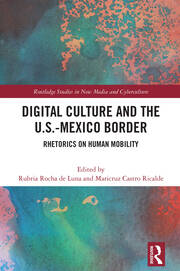
Digital Culture and the U.S.-Mexico Border Rhetorics on Human Mobility
Introduction
Rubria Rocha de Luna
Section 1: Memory, Identity, and Representation of Human Mobility through Social Media and Digital Archives
1. Digital Archives and Women’s Identity: Transborder Rhetorical Practices in Late 19th and Early 20th Century Periodicals
Donna Marie Kabalen Vanek
2. The Migrant Woman in the Language of the Mexican Digital Press
Elizabeth Tiscareño-García
Oscar Mario Miranda-Villanueva
3. Embracing the ‘American Dream’ Social Media Imaginary vs. the Daily American Nightmare for Immigrant Women
Miryam Espinosa-Dulanto
Iris Rubi Monroy-Velasco
4. Crossing the Darien with TikTok: Self-representation and Digital Solidarities in Forced Migrants from Venezuela in Transit to the U.S.
Alethia Fernández de la Reguera Ahedo
Alejandro Martin del Campo
Juan Carlos Narváez Gutiérrez
5. Music, Migration, and Mexicanness in the Digital World
Alfonso Meave Avila
Laura F. Morales
Section 2: Art and Imaginaries: Border Experiences Mediated by Technology
6. The Rhetoric of Empathy: Digital Storytelling Co-creators Seeking to Humanize Migration and Deportation
Maricruz Castro Ricalde
Rubria Rocha de Luna
7. Towards a Hyper-Aesthetics of Migration: Transnational Identities, Hyperborders, and Hypermediacy in the Visual Narratives of Evan Apodaca and Alex Rivera
Alejandro Ramírez-Méndez
8. Reimagining the U.S.-Mexico Borderlands through Contemporary Ecocritical Art
Emily Celeste Vázquez Enríquez
9. Rearticulating Ex-votos within Digital Spaces
Lorella Di Gregorio
10. Visual Imaginaries from Artificial Intelligence on the United States-Mexico Border.
Jacob Bañuelos Capistrán
Section 3: Digital Constraints: Representations and Modes of Border Political Control
11. Sleep Dealer (Alex Rivera, 2008): Reconfiguration of Limits/Borders in a Cyborg/Cybernetic Culture
Richard K. Curry
12. “Mi entrevista en Juárez”: The Digital Rhetorics of YouTube Immigration Videos
Sonia López-López
Spencer W. Martin
13. Higher Education for Dreamers Returning to Mexico: Vagueness of Official Communications from a User Experience Perspective
Juan Antonio Valdivia Vázquez
Daniel A. Arenas Aguiñaga
14. Engaging Action: Procedural Rhetoric and Agentive Arguments in Border Crossing Videogames
Justin Cosner
15. Migration Policy in Mexico and Situated Knowledge: The Denial of Justice as a Form of Discrimination
Salvador Leetoy
Carlos Cerda-Dueñas
Biography
Rubria Rocha de Luna is Postdoctoral Researcher in the Digital Humanities Research Group, School of Humanities and Education at Tecnologico de Monterrey, México.
Maricruz Castro Ricalde is Digital Humanities Co-leader in the School of Humanities and Education at Tecnologico de Monterrey, México.
