




1st Edition
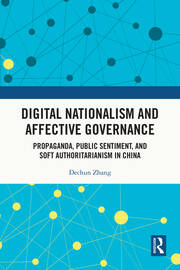
Digital Nationalism and Affective Governance Propaganda, Public Sentiment, and Soft Authoritarianism in China
1. Introduction 2. Society and Nationalism Turning Digital 3. Digital Propaganda and Nationalism in People’s Daily 4. The Emotional Mobilization in COVID-19 Propaganda 5. China’s Vaccine Nationalism from Top-Down and Bottom-Up 6. Digital Populist Nationalism and the Red Cross Scandal 7. Conclusion: Negotiating Power and Nationalism Online
Biography
Dechun Zhang (PhD, Leiden University) is a Postdoctoral Researcher in the Department of Communication at the University of Copenhagen. His work examines political communication, digital politics, propaganda, and online activism. He has published widely in international journals and edited volumes on political communication and digital media.
"The recent pandemic generated both intense online nationalism in China but also the expression of grievances. This well-researched book provides fascinating insights into the role played by social media, which may be a harbinger of things to come."
Ralph Schroeder, University of Oxford, UK
"Using the first wave of the COVID-19 pandemic as a case study, this book examines how nationalism is co-produced by state actors and citizens in China. It is particularly valuable for its detailed mapping of the discourses on one social media platform—Sina Weibo—in these processes."
Guobin Yang, University of Pennsylvania, USA
"This book offers a sharp, timely analysis of how digital nationalism took shape on Weibo during COVID-19, revealing the dynamic interplay between state messaging and grassroots expression. Through rich cases and a mixed-methods approach, it demonstrates how digital platforms mediate power, identity, and emotion, making a valuable contribution to understanding politics in the digital age."
Taberez Ahmed Neyazi, National University of Singapore, Singapore
