




1st Edition
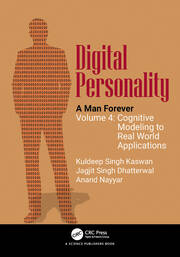
Digital Personality: A Man Forever Volume 4: Cognitive Modeling to Real World Applications
Preface
1. Introduction to Soar and Digital Personalities
Introduction to Soar Architecture
Fundamentals of Soar Cognitive Systems
Role of Soar Agent in Digital Personality Design
Mapping Soar’s Cognitive Framework to Digital Personality Models
Applications of Soar in AI-Driven Digital Entities
Conclusion
2. Computational Methods in Digital Personality Modeling
Optimization Techniques for Digital Personality Models in Soar
Parameter Tuning and Weight Adjustments for Personality Emulation
Task Decomposition and Goal-Driven Reasoning in Soar
Multi-Level Decision-Making and Conflict Resolution Strategies
Adaptive Problem-Solving Mechanisms in Digital Personalities
Conclusion
3. Human-Like Reasoning and Cognitive Modeling
Introduction of Human-Like Reasoning in Soar-Based Digital Entities
Cognitive Representation and Logical Processing in Soar
Statistical Techniques for Modeling Knowledge States in Soar
Probabilistic Inference and Decision-Making in Soar-Based Systems
Evaluating Knowledge Representation and Learning in Digital Personalities
Conclusion
4. Decision-Making Algorithms in Soar
Numerical Methods for Decision Cycles in Soar Architectures
Parameter Tuning in Soar Cognitive Systems
Weight Adjustments in Soar Cognitive Systems
Algorithms for Conflict Resolution in Soar-Driven Personalities
Optimizing Conflict Resolution in Soar-Based Personality Systems
Conclusion
5. Memory and Learning Mechanisms
Mathematical Representation of Episodic Memory in Digital Personalities
Quantitative Analysis of Chunking Mechanisms in Soar
Memory Retrieval Techniques for Digital Personalities
Optimization Techniques for Enhancing Memory Retrieval
Integration of Episodic Memory and Chunking Mechanisms in Soar
Conclusion
6. Adaptive Learning in Soar-Based Systems
Reinforcement Learning Algorithms in Soar
Adaptive Personality Models in Soar
Predictive Analytics for Digital Personality Simulation
Techniques in Soar for Personality Prediction
Emotional Modeling in Soar Architectures
Learning Mechanisms for Emotional Adaptation in Soar
Conclusion
7. Cognitive and Behavioural Simulations
Numerical Simulations of Goal-Driven Behaviour in Digital Personalities
Behavioural Pattern Recognition in Soar-Enabled Personalities
Emotion-Driven Decision Making in Soar with Mathematical Modeling
Goal-Oriented Behaviour in Digital Personalities
Pattern Recognition Algorithms in Soar
Mathematical Models for Emotion-Driven Decisions
Conclusion
8. Real-Time Cognitive Processing in Soar
Cognitive Load Analysis in Real-Time Applications
Understanding Cognitive Load in Soar Systems
Real-Time Processing in Soar Architectures
Optimizing Cognitive Loops for Soar-Based Systems
Enhancing Personality Systems with Cognitive Loop Optimization
Conclusion
9. Personality Profiling, Recognition and Reasoning
Numerical Approaches to Personality Profiling Using Soar Frameworks
Multi-Agent Interactions with Soar-Based Digital Personalities
Numerical Models for Temporal Reasoning in Digital Personalities
Simulating Interpersonal Skills in Soar-Driven Digital Assistants
Conclusion
10. Advanced Problem-Solving and Applications
Complex Problem Solving with Digital Personalities in Dynamic Environments
Building Digital Tutors with Soar Cognitive Architecture
Mathematical Modeling of Soar-Based Personality Interactions in Healthcare
Evaluating Soar in Personalized Virtual Assistants and Numerical Analysis
Conclusion
11. Case Studies of Soar in Digital Personalities
Introduction
Case Study: Implementing Soar Cognitive Architecture in Virtual Personalities or Customer Service Applications
Case Study: Soar-Driven Personalities in Adaptive Educational Systems for Personalized Learning
Case Study: Enhancing Healthcare Assistants with Soar-Based Emotional and Cognitive Modeling
Case Study: Real-Time Personalization of Virtual Assistants Using Soar’s Decision-Making Framework
Case Study: Multi-Agent Collaboration in Soar-Driven Digital Personalities for Complex Problem Solving
Conclusion
12. Future Directions and Challenges in Soar-Based Digital Personalities
Challenges in Soar-Based Digital Personalities
Future Directions
Conclusion
Index
Biography
Prof. Dr. Kuldeep Singh Kaswan is a distinguished academic figure, currently affiliated with the School of Computing Science & Engineering at Galgotias University in Uttar Pradesh, India. His extensive contributions are centered around the fields of Brain-Computer Interface (BCI), Cyborg technology, and Data Science. With a remarkable academic journey spanning seventeen years and experience garnered from esteemed global institutions such as Amity University, Noida; Gautam Buddha University in Greater Noida; and PDM University in Bahadurgarh, he has solidified his position as a leading expert in his domain. Dr. Kaswan holds a Doctorate in Computer Science from Banasthali Vidyapith in Rajasthan, a testament to his dedication to advancing knowledge in his field. He has also been awarded the prestigious Doctor of Engineering (D. Engg.) degree from the Dana Brain Health Institute in Iran, further enhancing his international recognition and expertise. A true mentor and guide, Dr. Kaswan has played a pivotal role in supervising numerous undergraduate and postgraduate projects for engineering students. He has authored 25+ books and contributed more than 150 book chapters, both at the national and international levels. His extensive body of work also includes numerous publications in esteemed international and national journals, as well as presentations at conferences.
Dr. Jagjit Singh Dhatterwal is an Associate Professor in the School of Computer Science & Artificial Intelligence at SR University, Warangal, Telangana, India. He has supervised numerous undergraduate and postgraduate engineering projects and is actively involved in academic research and mentorship. Dr. Dhatterwal is a member of several prestigious professional organizations, including the Computer Science Teachers Association (CSTA), New York, USA; the International Association of Engineers (IAENG), Hong Kong; the International Association of Computer Science and Information Technology (IACSIT), USA; the Association of Computing Machinery (ACM), USA; IEEE; and is a life member of the Computer Society of India (CSI). He has an extensive publication record, which includes more than 20 books, 140+ book chapters, and over 40 research papers published in reputed national and international journals and conferences. His areas of expertise include Artificial Intelligence, Brain–Computer Interfaces (BCI), Cyborg Technologies, and Multi-Agent Systems. Dr. Dhatterwal continues to contribute significantly to the academic community through his research, writing, and active participation in global professional societies.
Dr. Anand Nayyar received Ph.D (Computer Science) from Desh Bhagat University in 2017 in the area of Wireless Sensor Networks, Swarm Intelligence and Network Simulation. He is currently working in School of Computer Science-Duy Tan University, Da Nang, Vietnam as Professor, Scientist, Vice-Chairman (Research) and Director- IoT and Intelligent Systems Lab. A Certified Professional with 280+ Professional certifications from CISCO, Microsoft, CompTIA, Amazon, Alibaba Cloud, Oracle, Google, Salesforce, Tableau, FinOps, Beingcert, EXIN, GAQM, Cyberoam and many more. Published more than 225+ Research Papers in various High-Quality ISI-SCI/SCIE/SSCI Impact Factor- Q1, Q2, Q3, Q4 Journals cum Scopus/ESCI indexed Journals, 80+ Papers in International Conferences indexed with Springer, IEEE and ACM Digital Library, 60+ Book Chapters in various SCOPUS/WEB OF SCIENCE Indexed Books with Springer, CRC Press, Wiley, IET, Elsevier with Citations: (Google Scholar): 22000+, H-Index: 76 and I-Index: 306; (Scopus): 12300+; H-index: 59. Member of more than 60+ Associations as Senior and Life Member like: IEEE (Senior Member) and ACM (Senior Member). He has authored/co-authored cum Edited 70+ Books of Computer Science. Associated with more than 600+ International Conferences as Programme Committee/Chair/Advisory Board/Review Board member. He has completed 1 Grassroot and 1 ASEAN Project. He has 18 Australian Patents, 16 German Patents, 4 Japanese Patents, 44 Indian Design cum Utility Patents, 13 UK Patents, 1 USA Patent, 3 Indian Copyrights and 2 Canadian Copyrights to his credit in the area of Wireless Communications, Artificial Intelligence, Cloud Computing, IoT, Healthcare, Drones, Robotics and Image Processing. Awarded 55 Awards for Teaching and Research—Young Scientist, Best Scientist, Best Senior Scientist, Asia Top 50 Academicians and Researchers, Young Researcher Award, Outstanding Researcher Award, Excellence in Teaching, Best Senior Scientist Award, DTU Best Professor and Researcher Award- 2019, 2020-2021, 2022, 2022-2023, 2023-2024, Distinguished Scientist Award by National University of Singapore, Obada Prize 2023, Lifetime Achievement Award 2023, 2024; Asian Admirable Achievers 2024; Distinguished Academic Leader 2024, Lifetime Achievement Award 2024 and many more.
He is listed in Top 2% Scientists as per Stanford University (2020, 2021, 2022, 2023, 2024, 2025), Ad Index (Rank No:1 Duy Tan University, Rank No:2 Computer Science in Viet Nam) and Listed on Research.com (Top Scientist of Computer Science in Viet Nam- National Ranking: 2; D-Index: 56; World Ranking: 3694).
He is acting as Associate Editor for Computer Communications (Elsevier), International Journal of Sensor Networks (IJSNET) (Inderscience), Tech Science Press- IASC, Cogent Engineering, Human Centric Computing and Information Sciences (HCIS), IET-Quantum Communications, IET Networks, IEEE Transactions on Artificial Intelligence (IEEE TAI), Indonesian Journal of Electrical Engineering and Computer Science, IJFC, IJISP, IJDST, IJCINI, IJGC, IJSIR, IJBDCN, IJNR, IJSI, IJIES. He is acting as Managing Editor of IGI-Global Journal, USA titled “International Journal of Knowledge and Systems Science (IJKSS)”. He has reviewed more than 5700+ Articles for diverse Web of Science and Scopus Indexed Journals. He is currently researching in the area of Wireless Sensor Networks, Internet of Things, Swarm Intelligence, Cloud Computing, Artificial Intelligence, Drones, Blockchain, Cyber Security, Healthcare Informatics, Big Data and Wireless Communications.
