
1st Edition

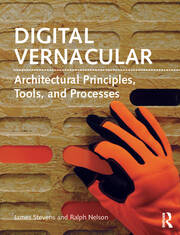
Digital Vernacular Architectural Principles, Tools, and Processes

By James Stevens, Ralph Nelson Copyright 2015
316 Pages 359 Color Illustrations
by Routledge

316 Pages 359 Color Illustrations
by Routledge

316 Pages 359 Color Illustrations
by Routledge

Digital Vernacular addresses the why and how of digital fabrication in hundreds of step-by-step color images, illuminating a set of working principles and techniques that join theory with practice. Authors James Stevens and Ralph Nelson reconcile local traditions and innovations with globally accessible methods and digital toolsets. By combining ethics with hardware, the book will root you in... Read more
Forewords by Branko Kolarevic and Michelangelo Sabatino  Preface  Acknowledgements  Introduction  1. Origins of the Digital Vernacular  1.1 On Origins  1.2 The Digital  1.3 The Vernacular  1.4 The Maker  2. Principles of the Digital Vernacular  2.1 On Principles  2.2 Place and Time  2.3 Evolution and Sufficiency  2.4 Logic and Limits  2.5 Play and Innovation  3. Tools of the Digital Vernacular  3.1 On Tools 3.2 Tool Evolution  3.3 Walk-In Toolbox  3.4 Discovery and Acceptance  3.5 Tool-Making  3.6 Open Source, Hacking, and Shopping Around  3.7 3-D Printer  3.8 Laser Cutter  3.9 CNC Mill  4. Processes of the Digital Vernacular  4.1 On Process 4.2 Guiding Precedent  4.3 Defining Proposition  4.4 Fabricating Preference  4.5 Removing  4.6 Joining  4.7 Forming  4.8 Adding  5. Evolutions of the Digital Vernacular  Image Credits  End Notes  Index

Biography

James Stevens is an Associate Professor and the Director of makeLab, a digital fabrication studio in the College of Architecture and Design at Lawrence Technological University in Michigan, USA.

Ralph Nelson is an Associate Professor in the College of Architecture and Design at Lawrence Technological University and Principal of Loom, a collaborative design practice, based in Ann Arbor, Michigan, USA.

"Digital Vernacular presents an easy to read and flowing text with articulated descriptions and step-by-step photographs. Undergraduate students especially will benefit from the basic knowledge presented in this book, as well as the range of tools and processes used." – Mine Özkar, Associate Professor, Istanbul Technical University, Turkey
