




1st Edition
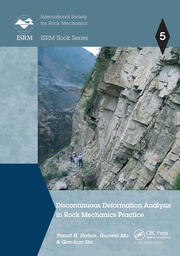
Discontinuous Deformation Analysis in Rock Mechanics Practice
Introduction
1.1 Who should read this book?
1.2 How to use this book?
1.3 Continuous vs. discontinuous deformation
1.4 DDA history
1.5 Three decades of DDA research and development
1.6 DDA vs. FEM and DEM
1.7 Main features of DDA
1.8 Some limitations of the original DDA
1.9 Block discretization
1.10 Higher order displacement function
1.11 Coupling DDA with other numerical methods
1.12 Improved contact algorithms
1.13 Incorporation of viscous damping
1.14 Improved friction law for discontinuities
1.15 Gravity turn on and sequential excavation
1.16 Dynamic wave propagation and blasting
1.17 Masonry structures
1.18 Improved rockbolt element
1.19 Granular materials
1.20 Pore pressure and fluid flow
1.21 Current development of 3-D DDA
2 Theory of the discontinuous deformation analysis (DDA)
2.1 Governing equations and displacement approximation
2.2 Formulation of matrices for each single block
2.3 Interactions between blocks
2.4 Time integration scheme and governing equations for blocky systems
2.5 Simplex integration for 2-D DDA
2.6 Summary
3 Theory of the discontinuous deformation analysis in three dimensions
3.1 Block displacement approximation and global equilibrium equation
3.2 Formulation of matrices for single block
3.3 Interactions among blocks
3.4 Simplex integration for 3D DDA
3.5 Summary
4 Geological input parameters for realistic DDA modeling
4.1 Introduction
4.2 Realistic representation of rock mass structure
4.3 Mechanical input parameters for forward modeling
5 DDA verification
5.1 Introduction
5.2 Single plane sliding
5.3 Double plane sliding
5.4 Block response to cyclic motion of frictional interface
5.5 Dynamic rocking of slender blocks
5.6 Wave propagation phenomena
6 Underground excavations
6.1 Introduction
6.2 Shallow underground excavations
6.3 Deep underground excavations
7 Rock slopes
7.1 Introduction
7.2 Rotational failure modes
7.3 Dynamic rock slope stability analysis
7.4 Rockbolt reinforcement
8 Shi’s new contact theory
8.1 Introduction
8.2 Geometric representations of angles and blocks
8.3 Definition of the entrance block
8.4 Basic theorems of entrance block
8.5 Boundaries of the entrance solid angles of 2D solid angles
8.6 Contact vectors of 2D solid angles
8.7 Boundaries of an entrance block of 2D blocks
8.8 Contact edges of 2D blocks
8.9 Boundaries of entrance solid angle of 3D solid angles
8.10 Contact solid angles of 3D solid angles
8.11 Boundaries of entrance block of 3D blocks
8.12 Contact polygons of 3D blocks
8.13 Conclusions
Biography
Yossef H. Hatzor
"This book brings the extraordinary power of DDA (Discontinuous Deformation Analysis) to the tool-baskets of engineers who are responsible for excavations and foundations in jointed and faulted rock masses. The mathematical basis for DDA originated in the brilliant PhD Dissertation and subsequent publications of Gen-hua Shi, and has been furthered by many applications in recent years. These include Professor Hatzor’s resourceful analyses of works needed to protect ancient surficial and underground structures in Israel. Important developments have been published in the proceedings of the International Assoc. for Computer Methods and Advances in Geomechanics, and in other recent engineering literature. With this book, the potential applications of DDA will be further recognized and applied for the benefit of the entire engineering community."
Professor Richard E. Goodman, Professor Emeritus at the department of Civil and Environmental Engineering, University of California, Berkeley.
