




1st Edition
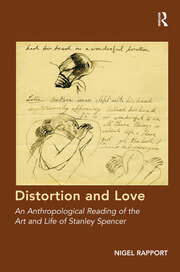
Distortion and Love An Anthropological Reading of the Art and Life of Stanley Spencer
Preface. Part I An Introduction to Stanley Spencer, Distortion, and Methodology: The anthropological project; Introducing Stanley Spencer as painter and as public figure; Introducing distortion as a concept; Methodological considerations, and doubts. Part II Stanley Spencer’s Vision: Painting love and redemption: Stanley’s metaphysics; Inspiration and the creative process: ‘definition through passion’; First conversation: ‘what kind of art is Stanley Spencer’s’?; 1932 to 1938: ‘the beatitudes of love’; Distortion and Stanley’s reaction to it; Second conversation: ‘what do Stanley Spencer’s distortions mean?’. Part III A Human Document: Distortion in individual consciousness and in social relations, and love; Third conversation: ‘the Stanley Spencer Gallery as labour of love?’. Bibliography; Indexes.
Biography
Nigel Rapport is Professor of Anthropological and Philosophical Studies and Head of the School of Philosophy, Anthropology, Film and Music at the University of St Andrews, UK. He has been elected a Fellow of the Royal Society of Edinburgh, and been awarded the Rivers Memorial Medal by the Royal Anthropological Institute. Among his recent books are: Reflections on Imagination; Social and Cultural Anthropology: The Key Concepts; and Anyone: The Cosmopolitan Subject of Anthropology.
'This remarkable work may well be the crowning achievement in Nigel Rapport’s already distinguished anthropological and literary oeuvre. Not only does Rapport succeed brilliantly in doing justice to Stanley Spencer’s eccentric life and his religious and distorted ways of seeing; he offers a stunning critique of an anthropology of art that has all too often privileged sociological reductions over in-depth explorations of the quiddity of things, the contingency of events, and the irreducibility of the individual.' Michael Jackson, Harvard Divinity School, USA
