




1st Edition
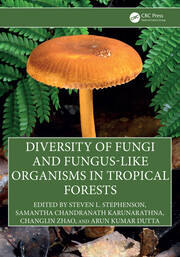
Diversity of Fungi and Fungus-Like Organisms in Tropical Forests
Chapter 1 Introduction to Tropical Forests and Their Associated Fungi and Fungus-Like Organisms
Steven L. Stephenson and Entaj Tarafder
Chapter 2 Diversity and Ecology of Macrofungi of Tropical India
Arun Kumar Dutta, Prakash Pradhan, Pinaki Chattopadhyay, Krishnendu Acharya, and Niranjan Roy
Chapter 3 Biodiversity of Wood-Rotting Fungi in Tropical Ecosystems of China
Changlin Zhao
Chapter 4 Diversity and Ecology of Macrofungi in Sri Lanka
Buddhika P. Dharmasena, Kasun M. Thambugala, Bhagya M. Premarathne, Isuru Sakbo Uyangoda, Samantha C. Karunarathna, and A. K Hasith Priyashantha
Chapter 5 Costa Rican Fungi: Present and Future
Melissa Mardones Hidalgo, Julieta Carranza Velázquez, and Carlos Rojas Alvarado
Chapter 6 Macrofungal Diversity in Colombia’s Tropical Forests: Insight From the Agaricomycetes (Basidiomycota)
Nataly Gómez-Montoya, Viviana Motato-Vásquez, Ana Cristina Bolaños Rojas, Carolina Ríos Sarmiento, Hannya A. Chamorro-Martínez, Yulena S. Osorio Navarro, Cristian Zambrano-Forero, Laura Vélez Jaramillo, Lina Rocío Davila Giraldo, Paola Andrea Zapata Ocampo, Salomé Gómez-Gómez, Alvaro Alexander Dávila Giraldo, Ana Esperanza Franco-Molano, and Denis Cristina Benjumea-Aristizábal
Chapter 7 Myxomycetes and Tropical Forests
Steven L. Stephenson
Chapter 8 Entomopathogenic Fungi and Tropical Forests
Leela Maya Rizal
Chapter 9 Dictyostelids Associated with Tropical Forests
Pu Liu, Zhaojuan Zhang, Jing Zhao, Zhao, Yu Li, and Yue Zou
Chapter 10 Mushrooms in the Topical Forests of Southeast Asia
Jaturong Kumla and Nakarin Suwannarach
Chapter 11 Diversity, Distribution, Threats, and Conservation Status of Macrofungi Communities in Kenya: A Synthesis of Literature and Citizen Science Data.
Mary Nyawira Muchane
Chapter 12 Diversity, Ecological Patterns, and Biogeography of Myxomycetes in Island
Tropical Forests: A Case Study from the Philippines
Thomas Edison E. dela Cruz, Sittie Aisha B. Macabago, and Nikki Heherson A. Dagamac, and Melissa H. Pecundo
Chapter 13 Fungi and Myxomycetes in Brazilian forests: Diversity, Ecology, and Conservation
Solange Xavier-Santos, Diogo Henrique Costa de Rezende, Elisandro Ricardo Drechsler-Santos, Laise de Holanda Cavalcante, and Lucas Leonardo-Silva
Chapter 14 Plant Fungal Pathogens in the Greater Mekong Subregion (GMS)
Tikka Dewage Chamarika Priyadarshani, Garumuni Dilrukshi Nadeeshani Manike, Mudugama Vidanage Sachini Sithma Mudugama, and Samantha C. Karunarathna
Chapter 15 Ectomycorrhizal Fungi of the Central Guiana Shield
Terry W. Hinkle
Chapter 16 Spegazzini’s Legacy Revisited: A Century of Fungal Rediscovery in Paraguay
Michelle G. Campi, Yanine E. Maubet, and Juliana Moura-Mendes
Biography
Steven L. Stephenson retired from the University of Arkansas in 2023, where he was a research professor in the Department of Biological Sciences. He received his Ph.D. from Virginia Polytechnic Institute and State University and taught at Fairmont State University for 27 years before moving to the University of Arkansas. During his academic career, he has been a senior Fulbright scholar at Himachal University in India, a visiting scientist at the Australian Antarctic Division, and the William Evans visiting fellow at the University of Otago in New Zealand. He also has received Fulbright Specialist awards to India and Vietnam. Stephenson has carried out research on eumycetozoans and fungi in the forests of India, Australia, New Zealand, Thailand, Peru, Ecuador, Puerto Rico, and Costa Rica. He is the author or coauthor of more than 500 papers and 20 books on eumycetozoans, fungi, and various aspects of ecology.
Samantha Chandranath Karunarathna is a professor at the Center for Yunnan Plateau Biological Resources Protection and Utilization in the College of Biological Resource and Food Engineering of Qujing Normal University, Qujing, Yunnan, People’s Republic of China. Karunarathna has vast experience in fungal taxonomy, phylogeny, and their economic importance. He has published over 300 SCI papers related to fungal taxonomy and phylogeny. He also received Yunnan Talent and Friendship Awards in 2022 and was recognized as one of the world’s top 2% scientists in 2022, 2023, 2024, and 2025, according to rankings by Stanford University.
Changlin Zhao works in the College of Forestry at the Southwest Forestry University of the People’s Republic of China. Currently, his research is focused on the taxonomy and phylogeny of wood-decaying fungi (Basidiomycota). He received a Ph.D. degree from Beijing Forestry University (2016), studied evolutionary biology at Harvard University as a joint Ph.D. during 2014 and 2015, and worked at Tsinghua University as a senior visiting scholar from 2021 to 2022. He is the first author or corresponding author of more than 150 publications and five books (as first editor) in mycology.
Arun Kumar Dutta is currently working as an assistant professor of botany at Gauhati University, Assam, India. Prior to this position, he worked at West Bengal State University as a DST-Inspire Faculty Fellow. Dutta has received numerous prestigious awards, including the ISCA Young Scientist Award for 2017–2018 given by the Indian Science Congress Association (Section: Plant Sciences) and the DST-Inspire Faculty Award of the Department of Science and Technology, India, in the fields of plant, animal, and agricultural sciences (2018). He earned his Ph.D. in botany with a specialization in mycology from the University of Calcutta, West Bengal, India, in 2017. Dutta began his research career by investigating the diversity of marasmioid and gymnopoid fungi of West Bengal, utilizing both morphological and molecular characteristics. Currently, his research focuses on the molecular systematics of wild edible macrofungi in Eastern India and examining their potential as nutraceuticals. To date, he is the author of 100 peer-reviewed papers in national and international journals.
