
1st Edition

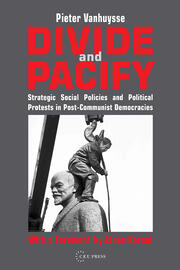
Divide and Pacify Strategic Social Policies and Political Protests in Post-Communist Democracies

By Pieter Vanhuysse Copyright 2006
190 Pages
by Central European University Press

190 Pages
by Central European University Press

Despite dramatic increases in poverty, unemployment, and social inequalities, the Central and Eastern European transitions from communism to market democracy in the 1990s have been remarkably peaceful. This book proposes a new explanation for this unexpected political quiescence. It shows how reforming governments in Poland, Hungary and the Czech Republic have been able to prevent massive waves... Read more
Chapter 1 Introduction, Chapter 2 The unexpected peacefulness of transitions, Chapter 3 Political quiescence despite conditions for conflict, Chapter 4 Preventing protests: Divide and pacify as political strategy; Chapter 5 The Great Abnormal Pensioner Booms: Strategic social policies in practice, Chapter 6 Peaceful pathways: The political economy of post-communist welfare, Chapter 7 Conclusions, Appendices, References, Endnotes

Biography

Pieter Vanhuysse obtained his PhD at the London School of Economics. A former fellow of the Institute for Advanced Study at Collegium Budapest and the Higher Education Committee of the State of Israel, he currently holds a joint appointment as Lecturer in Political Economy at the School of Political Sciences and the Faculty of Education of the University of Haifa. His work centers on the politics of social policy, education, human capital, and democratic transitions.

János Kornai is Professor Emeritus of Harvard University, Permanent Fellow Emeritus of Collegium Budapest, Institute for Advanced Study and Distinguished Research Professor of Central European University, Budapest. He is member of the Hungarian Academy of Sciences and of several foreign academies.
