




1st Edition
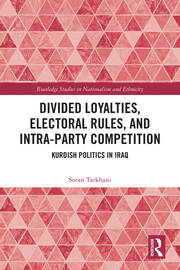
Divided Loyalties, Electoral Rules, and Intra-Party Competition Kurdish Politics in Iraq
Part I: Rethinking Ethnic Party Politics Chapter 1. Breaking the Mold: Rethinking the Ethnic Outbidding Paradigm Chapter 2. Rethinking Rivalry: A New Framework for Intraethnic Party Politics Chapter 3. Origins of Division: How Ethnic Groups Form Distinct Party Systems Part II: Structures and Strategies of Intraethnic Contestation Chapter 4. Rules That Divide: Electoral Institutions and Party Fragmentation Chapter 5. Beyond Identity: Programmatic Politics in Iraqi Kurdistan Chapter 6. The Rules of the Game: Institutional Incentives and Strategic Behavior
Biography
Soran Tarkhani is Assistant Professor of Political Science and History at Hampton University. His research examines ethnic politics, party competition, and conflict in the Middle East, with particular attention to Kurdish movements and regional alliances. His peer-reviewed articles appear in Nationalism and Ethnic Politics and Kurdish Studies Journal. His first monograph, Divided Loyalties: Electoral Rules, Societal Cleavages, and Intra-Kurdish Party Competition in Iraqi Kurdistan (Routledge, 2025), offers a comparative framework linking electoral design, subethnic cleavages, and regional alliances to patterns of cooperation and rivalry among Kurdish parties.
"Many observers of Iraqi Kurdistan have trouble understanding intra-Kurdish divisions there, especially when the leading political parties of the Region do not appear very ideologically different. Dr. Tarkhani's book offers us easy to understand, keen theoretical insights as to the 'how' and 'why' of these divisions. In doing so, he also offers us a very useful map to understand intra-ethnic rivalries in both Kurdistan as well as a wide variety of other contexts."
David Romano, Thomas G. Strong Chair in Middle East Politics at Missouri State University
"Divided Loyalties examines how electoral systems, sub-ethnic cleavages, and regional geopolitics have shaped the evolution of Kurdish political parties in post-1991 Iraq. Drawing on extensive fieldwork, archival sources, and electoral data, Soran Tarkhani challenges the ethnic-outbidding model by showing that intra-Kurdish competition is not simply driven by nationalist zeal, but also mediated by institutional incentives, patronage networks, and cross-border dependencies. Thus, this penetrating analysis contributes to broader debates on democratization, federalism, and political survival within non-sovereign territories."
Michael M. Gunter, Professor of Political Science at Tennessee Tech University
"Soran Tarkhan's book is a very important addition to the growing library on the Kurds and Kurdistan. The problem that has bedeviled the Kurds from time immemorial was the divisions among themselves. Tarkhan presents an illustration of such division between two leading camps in Kurdistan of Iraq. This case study goes a long way to explain the Kurds' failure to establish a state of their own."
Professor Ofra Bengio, Tel Aviv University
